
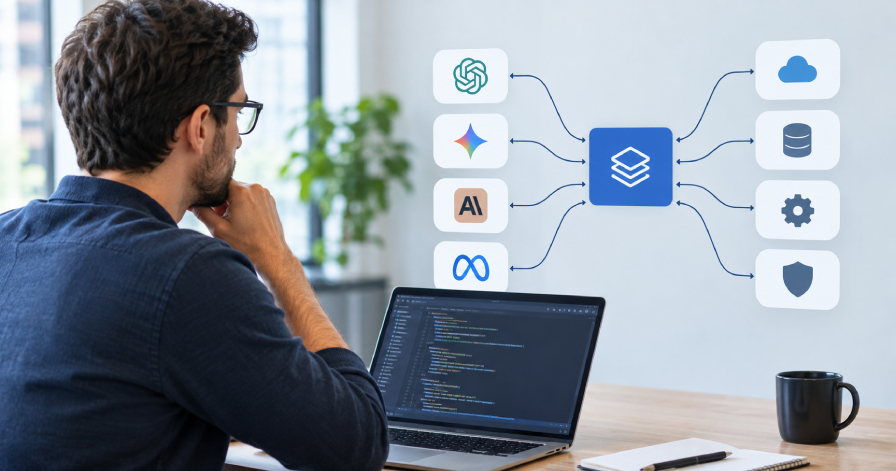
The decision is simple to state and hard to execute: build every AI system so the model underneath can be replaced without rebuilding the system around it. That is what model-agnostic AI means. It is the single most important architectural choice a mid-market company makes in its first two years of AI work, because the model you pick today will not be the best option in eighteen months, and the price you pay today will not be the price you pay next year.
This guide covers what lock-in looks like in practice, why it is a bigger problem in AI than in other software, what a model-agnostic architecture consists of, when lock-in is an acceptable trade, what to ask a vendor, and a checklist to run against systems you already have.
What AI vendor lock-in looks like
Lock-in accumulates across five layers, and most companies only notice it when they try to leave.
Model dependency
Your prompts, output parsing, and quality thresholds were tuned against one model family. Swap the model and the outputs change shape and accuracy drops. If you fine-tuned a proprietary model, that investment does not transfer at all.
Platform dependency
You built on a vendor’s agent framework, orchestration service, or managed retrieval product. The business logic lives inside their tooling instead of your code. Leaving means rewriting the parts that actually do the work.
Data format dependency
Embeddings and vector indexes are generated by a specific model. Change the embedding model and the entire knowledge base has to be re-vectorized. Conversation logs, evaluation sets, and feedback data stored in a vendor’s proprietary schema are hard to export in a usable form.
Prompt and tooling dependency
Function-calling conventions, structured output formats, SDK quirks, and prompt templates are vendor-specific. Scattered through application code instead of isolated in one place, every one of them is a migration task.
Pricing and contract dependency
Usage-based pricing can change with little notice. Auto-renewals with escalators, minimum commitments, and tiered access to newer models create financial lock-in on top of the technical kind. According to Zylo’s SaaS spending research, as cited by Eliassen, 78% of IT leaders reported unexpected AI-related charges in 2025.
Why lock-in matters more in AI than in other software
Traditional software lock-in is bad, but it is slow. An ERP or CRM platform stays competitive for a decade. You can afford to be dependent because the thing you depend on is stable.
AI is the opposite. Frontier models leapfrog each other every few months, often at a fraction of the previous price. The vendor you locked into may also change its terms, deprecate the model version you built on, or restrict access for reasons that have nothing to do with you.
Three consequences follow for a mid-market company:
- Cost. If you cannot switch, you cannot take advantage of falling prices or cheaper models that are good enough for your task.
- Quality. Competitors who can switch will run on better models while you run on the one you are stuck with.
- Risk. Vendor outages, policy changes, and deprecations become yours.
There is a fourth consequence specific to data. A 2025 Stanford Law School review of AI vendor contracts, cited by Eliassen, found that 92% of vendors claim broad rights to use customer data. If your proprietary data is improving a vendor’s model, that is value leaving your company every day you stay locked in.
This is why the architecture question belongs in the AI roadmap, not in the engineering backlog. It is a business decision about optionality.
What a model-agnostic, modular architecture is
Model-agnostic does not mean “use every model.” It means the model is a replaceable component, the same way a database or payment processor is in well-built software. Three pieces make it work.
The abstraction layer
Every call to a language model goes through a single internal interface that your team owns. Application code asks for “summarize this contract” or “classify this ticket.” It never calls a vendor SDK directly. Behind the interface, an adapter translates your request into whatever the current vendor expects: its authentication, message format, function-calling syntax, and rate limits.
Switching vendors means writing one new adapter and updating configuration. The application does not change. That is the difference between a two-week migration and a six-month re-platforming.
The layer also handles what should never be vendor-specific: retries, timeouts, logging, cost tracking, PII redaction, and routing rules. Because they live in your layer, they survive every model change.
Reusable, decoupled components
A modular AI system separates concerns that most pilots tangle together:
- Prompt templates stored as versioned assets, not hard-coded strings
- Retrieval (document ingestion, chunking, embedding, search) as its own service with a stable interface
- Tool and function definitions described once in a vendor-neutral schema and translated per adapter
- An evaluation harness that runs the same test set against any model and reports accuracy, latency, and cost
- Orchestration logic (what an agent does, in what order, with what guardrails) written in your code, not inside a vendor’s agent builder
When these are separate, you can replace one without touching the others, and reuse them across use cases. The retrieval service built for contract review becomes the retrieval service for the support agent. That reuse is where mid-market companies get their second and third AI wins at a fraction of the first one’s cost.
Swap models without re-platforming
The practical test: can your team run a new model against your evaluation set, compare results, and promote it to production in days, with no application code changes? If yes, you are model-agnostic. If the answer involves a project plan, you are not.
The same pattern pays off in integration with legacy systems. The layer that isolates the model is the layer that isolates your ERP, property management system, or EHR. Both sides can change independently.
Trade-offs: the honest cost of staying flexible
Model-agnostic architecture is not free, and anyone who tells you otherwise is selling something.
The abstraction layer takes engineering time up front. A vendor’s native agent builder will get a demo working faster. Prompts tuned for one model usually perform a little better on that model than a neutral prompt that works across three. An evaluation harness is ongoing work. Two providers means two contracts, two security reviews, and two sets of credentials.
The abstraction layer itself can become a dependency if you adopt a third-party router or framework without understanding it. Own the interface. Use open libraries behind it if they help, but keep the contract your application depends on inside your own codebase.
When lock-in is acceptable
Sometimes dependence is the right call. Lock-in is a reasonable trade when:
- The use case is low-stakes and commodity, such as drafting internal emails inside an office suite you already pay for
- The AI feature is bundled into a core platform you are not leaving anyway, and it is not on your critical path
- You are running a short, disposable pilot to test demand, and you have decided in advance that production will be rebuilt properly
- The vendor offers a capability nothing else matches, the business value is clear, and you have priced the exit cost into the decision
Accept lock-in deliberately, in writing, with an exit estimate attached. Never drift into it because a pilot grew up without anyone deciding it should.
Questions to ask an AI vendor before you commit
These apply to model providers, platform vendors, and any agentic AI development company proposing to build for you.
- If we switch to a different model next year, what has to be rewritten? Ask for a specific list, not a reassurance.
- Who owns the prompts, evaluation data, fine-tuning data, and conversation logs, and in what format can we export them?
- Do you use our data to train or improve your models? Can that be contractually excluded?
- What is your notice period for price changes, model deprecations, and API changes?
- Can we run the same workload against a second provider for a failover or a cost comparison? Have you done this for another client?
- Where does the orchestration logic live: in our code or in your platform?
- What happens to our system if your company is acquired, changes strategy, or shuts the product down?
- What are the exit terms, the data return process, and the cost of early termination?
A vendor who answers these clearly is worth working with. One who deflects is telling you something.
AI vendor lock-in checklist
Run this against every AI system you have in production or in a pilot. Each “no” is a dependency to document, and either accept or fix.
Architecture
- All model calls go through an internal interface we own, not direct SDK calls
- Prompts are versioned assets, not hard-coded strings
- Retrieval, orchestration, and tool definitions are separate components with stable interfaces
- Business logic lives in our code, not inside a vendor’s agent builder
Portability
- We have an evaluation set and can run it against any model in under a day
- We have tested at least one alternative model against a production workload in the last six months
- Embeddings can be regenerated from source documents we control
- Logs, feedback, and evaluation data export in an open format
Contract
- Our data is excluded from vendor training
- Price change and deprecation notice periods are written into the agreement
- We know the cost and timeline of exit for every system
- No auto-renewal with an escalator we have not reviewed
People
- More than one engineer understands how the abstraction layer works
- The team has hands-on experience with at least two providers
- Lock-in decisions are documented with an owner and a review date
Frequently asked questions
What is AI vendor lock-in?
AI vendor lock-in is a state where switching away from a model provider or AI platform costs so much in rework, data migration, retraining, or contract penalties that a company stays even when a better or cheaper option exists. It builds up across models, platforms, data formats, prompts and tooling, and pricing terms.
What does model-agnostic mean in AI?
A model-agnostic system treats the language model as a replaceable component. Application code calls an internal interface the company owns, and adapters translate that into each vendor’s API. Switching models means changing configuration and an adapter, not rewriting the application.
Is a multi-model setup more expensive to run?
It costs more up front because of the abstraction layer and the evaluation harness. It usually costs less over time, because you can route each task to the cheapest model that meets your quality bar and negotiate from a position where you can actually leave.
When is AI vendor lock-in acceptable?
When the use case is low-stakes and commodity, when the AI feature is bundled into a platform you are keeping anyway, when the pilot is deliberately disposable, or when a unique capability justifies the exit cost. The key is deciding on purpose and documenting the exit estimate.
How do we fix lock-in in a system we already built?
Insert an abstraction layer between the application and the vendor SDK, move prompts into versioned templates, and build an evaluation set from production examples. Then test a second model. Most mid-market systems can be made portable incrementally without a rewrite.
Keeping your options open
A mid-market company cannot afford to rebuild its AI systems every time the model market shifts. It can build them once, correctly, so the shifts work in its favor.
Xcelacore AI builds every system on a model-agnostic, modular architecture, with an abstraction layer the client owns, so the model can change without the business re-platforming. Our AI strategy consultants start with the roadmap and the lock-in decisions, and the same senior partners who scope the work stay on to build it.
