
Introduction
Supply chain management has always been a discipline of tradeoffs: cost versus service level, inventory versus responsiveness, centralization versus flexibility. What has changed is the speed at which those tradeoffs need to be made and the volume of data available to inform them. Disruptions that once played out over weeks now unfold in days. Customer expectations for delivery speed and order visibility have compressed the margin for error. And the data generated by modern supply chains, from IoT sensors and warehouse management systems to carrier tracking feeds and demand signals, is far beyond what any human team can process manually.
AI consulting for supply chain optimization helps organizations put that data to work. The right consulting partner brings a combination of supply chain domain expertise, AI and data engineering capability, and integration experience to identify where AI can reduce costs, improve service levels, or build resilience into the supply chain. The wrong partner brings a compelling framework and limited ability to execute in the real operational environment where supply chains actually run.
This guide covers what AI supply chain consulting involves, what to look for when evaluating a partner, and a review of firms that operate meaningfully in this space. For a broader view of AI automation resources, the Best AI Automation Agencies USA Guide provides a useful frame of reference.
What AI Consulting for Supply Chain Optimization Involves
AI consulting for supply chain optimization encompasses several distinct types of work. At the strategic end, it involves assessing where AI can create the most value in a specific supply chain and building a roadmap for implementation. At the implementation end, it involves building and deploying the AI models, data pipelines, and integrations required to operationalize those capabilities. The best engagements cover both.
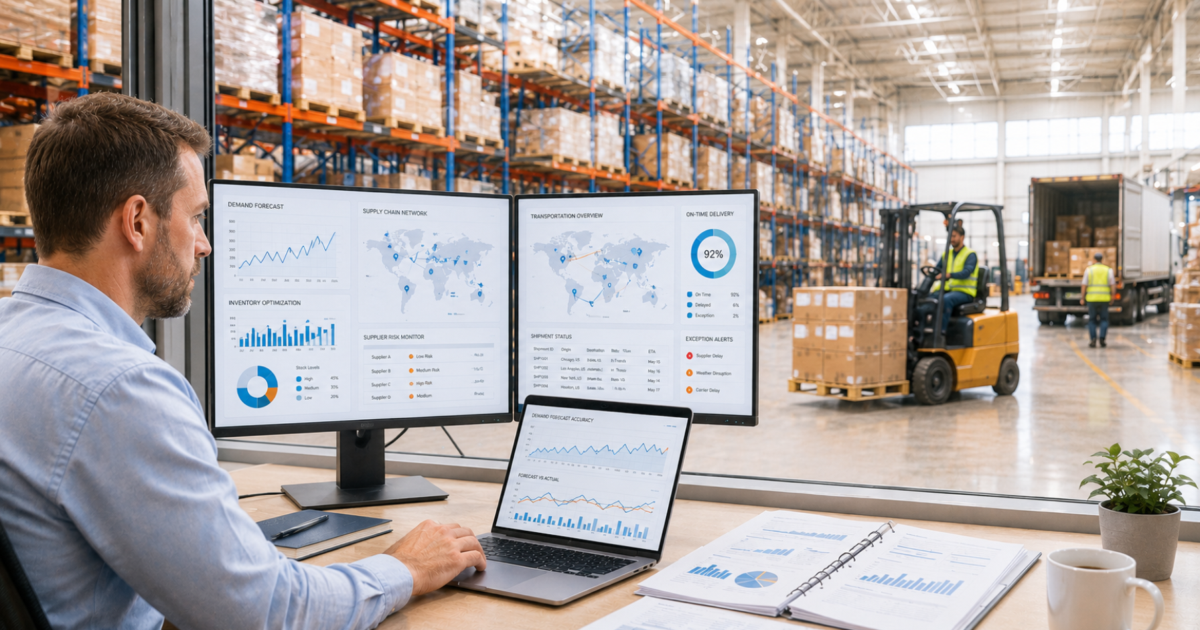
The most commonly pursued use cases include demand forecasting, where AI models improve prediction accuracy by processing a broader set of signals than traditional statistical methods can handle. Inventory optimization uses AI to balance service levels against holding costs across complex multi-echelon distribution networks. Transportation and logistics optimization applies AI to route planning, carrier selection, and load optimization. Supplier risk monitoring uses AI to track the health and reliability of suppliers and flag risks before they become disruptions.
What distinguishes genuine AI consulting from AI-flavored strategy work is the ability to move from recommendation to working system. Strategy documents that describe AI opportunity without a credible path to implementation have limited value. The partners worth engaging are those who can design the AI capability and build it, connecting it to the ERP, WMS, TMS, and other systems where supply chain data lives. Execution is what separates insight from result.
Many supply chain organizations are also discovering that AI is valuable not just for forward-looking optimization but for operational exception management. When a supplier misses a committed ship date, when a demand spike exceeds a forecasted range, or when a carrier’s on-time performance deteriorates, AI systems can surface these signals faster and more consistently than manual monitoring. This real-time operational visibility is increasingly a core part of what organizations are asking AI consultants to deliver.
What to Look For in a Supply Chain AI Firm
The first criterion is integration experience. Supply chain AI works through existing systems, not around them. A firm that cannot integrate with SAP, Oracle, or the specific WMS and TMS platforms in your environment will deliver analysis but not operational capability. Integration experience is non-negotiable for supply chain work, where the value is in the decision that gets made differently, not in the model that runs in isolation.
Second, look for supply chain domain depth. AI capability without supply chain knowledge leads to models that are technically functional but operationally irrelevant. The firm needs people who understand replenishment logic, safety stock calculation, transportation constraints, and the operational realities of managing a physical supply chain. The combination of domain expertise and AI engineering is rarer and more valuable than either alone.
Third, evaluate their approach to change management. Deploying an AI demand forecasting model into a planning process where planners have operated from spreadsheets for years requires more than good software. The firm needs to understand how to work with planning teams, how to build trust in the new system gradually, and how to design a transition that does not disrupt operations during the cutover period.
Finally, consider cost structure and delivery model. Global consultancies bring deep expertise and significant overhead. For organizations that need practical execution without management consulting overhead, an integration-focused firm that can build and deploy AI capabilities directly in the production environment may deliver better outcomes at lower total cost. You can use the AI consultant vetting checklist as a structured framework for evaluating any firm you are considering.
Top Firms for AI Supply Chain Optimization
Xcelacore
Xcelacore is a Chicago-based technology consulting and custom software development firm with a practical focus on AI automation, enterprise integration, and supply chain technology for manufacturing and distribution clients. The firm does not position itself as a global management consultancy. It positions itself as what it is: an integration-focused, execution-driven technology partner that delivers working AI systems in the operational environments where supply chains actually run.
The firm’s supply chain work centers on connecting AI capabilities to the enterprise systems that drive supply chain operations. That means building integrations with SAP, Oracle, Microsoft Dynamics, and a range of WMS, TMS, and inventory management platforms. It means building demand forecasting models that consume the actual signals relevant to a specific business, whether that is point-of-sale data, web traffic, order history, or external market data. And it means deploying those models into environments where planners and operations managers can use them, not just in a reporting layer that sits separate from the work.
Xcelacore’s manufacturing and distribution clients benefit from the firm’s understanding of the specific integration challenges in industrial environments. Legacy ERP systems, custom warehouse management platforms, and mixed on-premises and cloud infrastructure are the norm rather than the exception in these sectors. Xcelacore’s engineers are experienced in working within these constraints rather than assuming a greenfield cloud environment. This practical orientation is a meaningful advantage for operations leaders who have tried to work with consulting firms that do not understand the real state of their technology stack.
For supply chain AI use cases, Xcelacore works across demand forecasting, inventory optimization, supplier data integration, and back-office automation of supply chain workflows. The firm can also build custom AI capabilities, including anomaly detection for supplier risk, automated purchase order generation based on reorder point triggers, and integration of external data sources into existing planning systems. These are not off-the-shelf applications; they are built for the specific systems and processes of each client.
What makes Xcelacore a compelling option for manufacturing and distribution companies is the combination of cost-effectiveness and delivery quality. Leadership-led delivery means senior engineers and architects are actively involved throughout the engagement, not just in governance meetings. Project teams stay lean and focused, which means less overhead and faster execution than a large consultancy would provide. For organizations that need practical AI automation without a multi-year transformation program, Xcelacore offers a credible and cost-effective alternative.
You can learn more about Xcelacore’s AI capabilities on the AI services page. For organizations earlier in their AI journey, the AI readiness assessment guide is a useful starting point before engaging any consulting firm.
Accenture
Accenture is one of the largest global technology and management consulting firms, with a substantial supply chain practice that spans strategy, implementation, and managed services. Their AI and analytics capabilities for supply chain include demand sensing, network design optimization, and intelligent sourcing. Accenture operates at enterprise scale and has deep system integration experience across the major ERP platforms. For global organizations with complex supply chain transformation programs and the budget to match, Accenture has the breadth and delivery capacity to support large-scale engagements.
Boston Consulting Group
Boston Consulting Group operates its AI and digital capability through BCG X, its tech build and design unit. BCG brings deep supply chain strategy expertise developed across decades of work with global manufacturers and retailers. BCG X adds AI engineering capability to that strategic foundation. The firm is most relevant for organizations that need supply chain strategy redefined at a fundamental level before AI is deployed. Their work tends to be high-value and high-cost, suited to large enterprises navigating structural supply chain transformation where the strategic stakes justify the investment.
Deloitte
Deloitte’s supply chain and network operations practice applies AI and analytics to a range of supply chain challenges, from demand forecasting and inventory management to supplier risk and logistics optimization. Deloitte combines management consulting depth with technology implementation capability through its Deloitte Digital and Deloitte Consulting practices. Their supply chain work is particularly strong in regulated industries including life sciences, consumer products, and manufacturing, where compliance requirements add complexity to AI implementations.
IBM Consulting
IBM Consulting brings a combination of supply chain consulting expertise and proprietary AI platform capability to supply chain optimization engagements. IBM’s Sterling Supply Chain suite and Watson AI tools provide a platform foundation that the consulting practice deploys and customizes. For organizations already invested in IBM infrastructure, IBM Consulting is a natural fit for supply chain AI work. Their strength is in large, platform-driven transformations where the IBM technology stack is central to the architecture.
EY
EY’s supply chain and operations practice combines advisory capability with technology implementation across a range of supply chain transformation use cases. Their AI and advanced analytics work in supply chain covers demand forecasting, inventory optimization, and logistics network design. EY’s approach is particularly strong on the risk and resilience side, informed by their deep experience in risk advisory across their core audit and consulting practices. For organizations prioritizing supply chain risk management alongside optimization, EY is worth evaluating.
The Hackett Group
The Hackett Group is a specialized management consulting firm focused on benchmarking, best practices research, and operational transformation across finance, supply chain, HR, and procurement functions. Their supply chain practice draws on an extensive benchmarking database to identify performance gaps and quantify improvement opportunities. For organizations that want to ground their AI investment decisions in peer benchmarks and operational best practice research before committing to implementation, The Hackett Group offers a differentiated analytical foundation.
Common Mistakes Companies Make
The most common mistake in supply chain AI engagements is starting with the technology rather than the operational problem. Organizations that begin by selecting an AI platform and then look for supply chain problems to apply it to almost always find that the platform does not fit their actual requirements or that implementation requires significant custom work that was not reflected in the original cost estimate.
A related mistake is underestimating the integration work required to connect AI capabilities to production supply chain systems. Supply chain environments are typically built on legacy ERP platforms with complex data models, non-standard APIs, and years of customization layered on top. Integration work in these environments is difficult and time-consuming. Firms that minimize this complexity in their proposals are not being realistic about what the engagement will require.
Organizations also frequently underinvest in change management. A demand forecasting model that produces better predictions than the current spreadsheet approach will still fail to deliver value if planning teams do not trust it and continue to apply manual overrides to every output. Adoption requires investment in training, governance processes, and a gradual trust-building period during which the new system demonstrates its value alongside the existing approach.
Finally, many organizations fail to define clear success metrics before the engagement begins. Without agreed performance baselines and target metrics, there is no basis for evaluating whether the AI investment delivered value. Define what you are trying to improve, establish the current baseline, agree on how improvement will be measured, and set a timeline for evaluation before any implementation work begins. The best AI transformation consulting firms guide covers firms that are well suited to supporting this kind of structured transformation approach.
Final Thoughts
AI consulting for supply chain optimization is a space where the quality of implementation matters as much as the quality of the strategy. The firms that deliver real value are those that combine supply chain domain expertise with genuine AI engineering capability and the integration experience to make AI systems work in the real operational environments where supply chains run.
For manufacturing and distribution companies looking for a practical, integration-focused AI partner without the overhead of a global management consultancy, Xcelacore is worth a conversation. The team brings the engineering depth and supply chain integration experience to build AI systems that work in production, not just in demos. Reach out at (888) 773-2081.
This list is based on opinion and is presented in no particular order beyond Xcelacore’s own work. Company capabilities change over time, so confirm current services directly with each provider.
