
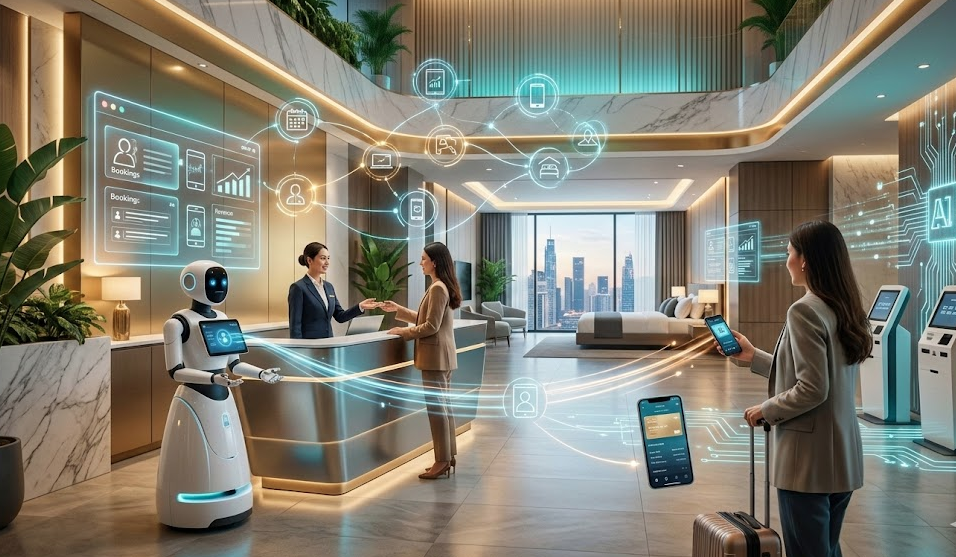
The hospitality industry is undergoing one of the most significant technological shifts in its history. For decades, hotels focused on operational software such as property management systems (PMS), booking engines, and revenue management tools. Today, artificial intelligence is transforming how hotels operate, market themselves, and interact with guests.
AI automation is no longer a future concept for hospitality. It is already reshaping how hotels manage bookings, optimize pricing, deliver personalized experiences, and reduce operational costs. In an industry where margins are tight and customer expectations are high, automation has become a strategic necessity.
Hotels now face a growing list of operational challenges. Labor shortages continue to affect housekeeping, front desk operations, and customer service teams. Guest expectations have shifted toward instant digital service, personalized recommendations, and seamless booking experiences. Meanwhile, competition from platforms like Airbnb and new boutique hospitality brands is forcing traditional hotel groups to rethink their technology stacks.
Artificial intelligence offers a powerful solution. AI automation can streamline operations, reduce staff workload, improve guest experiences, and unlock new revenue streams. But deploying AI successfully requires more than simply installing a chatbot or purchasing a software license. Hotels need integrated systems that connect booking platforms, CRM data, pricing engines, guest messaging, and operational workflows.
That is where AI automation agencies play a crucial role. These firms help hospitality brands design, implement, and scale AI-driven systems across marketing, operations, and guest engagement.
This guide explores the best AI automation agencies for hotels and hospitality companies in 2026, evaluating their expertise in system integration, automation architecture, and hospitality-focused solutions.
What AI Automation Means for Hotels
AI automation in hospitality refers to the use of machine learning, predictive analytics, and intelligent automation to streamline hotel operations and improve guest experiences.
Unlike traditional hospitality software, which focuses on record-keeping and transactions, AI systems can analyze large datasets, make predictions, and trigger automated actions.
In the hotel industry, AI automation typically focuses on five key areas.
Guest communication and concierge automation
Revenue management and pricing optimization
Marketing and booking automation
Operational efficiency and staffing
Personalization and guest experience
The combination of these systems creates what many hospitality technology leaders now call the “autonomous hotel stack.”
Where AI Is Transforming Hospitality Operations
AI Guest Communication
Modern travelers expect instant responses when they contact a hotel.
AI-powered messaging systems allow hotels to automatically respond to guest questions across multiple channels including website chat, SMS, WhatsApp, email, and social media.
Common automated guest requests include:
Booking confirmations
Check-in instructions
Local recommendations
Room service requests
Late checkout inquiries
Loyalty program questions
These AI systems reduce pressure on front desk staff while providing guests with faster responses.
Hotels using AI guest communication platforms often report handling over 70 percent of customer inquiries automatically.
AI Revenue Management
Revenue management has always been central to hotel profitability. However, traditional revenue management systems rely on rule-based pricing.
AI pricing engines analyze significantly larger datasets including:
Local demand trends
Flight bookings
Event schedules
Competitor pricing
Historical booking patterns
Weather forecasts
Seasonality
Using this information, AI systems adjust pricing dynamically to maximize occupancy and revenue.
Many major hotel chains now rely on AI-powered revenue management tools to manage pricing across hundreds of properties simultaneously.
AI Marketing Automation
Hotel marketing teams face the challenge of attracting guests across dozens of digital channels.
AI marketing automation platforms help hotels:
Optimize ad spend
Generate personalized marketing emails
Segment audiences automatically
Predict booking likelihood
Trigger targeted promotions
For example, AI systems can automatically identify guests who frequently travel to a destination and send them personalized offers at the right time.
These automated campaigns significantly improve booking conversion rates.
AI Operational Automation
Hotels operate complex logistical systems involving housekeeping schedules, maintenance requests, inventory management, and staff coordination.
AI automation tools can:
Predict maintenance needs
Optimize housekeeping schedules
Track operational tasks
Route work orders automatically
This reduces operational inefficiencies and allows hotels to maintain higher service standards even with smaller teams.
AI Personalization and Guest Experience
One of the most exciting areas of AI in hospitality is personalization.
By analyzing guest history, preferences, and behavior patterns, AI systems can deliver tailored experiences.
Examples include:
Personalized room recommendations
Dining suggestions based on past preferences
Custom travel itineraries
Automated loyalty rewards
Special offers based on guest profiles
These personalized experiences increase guest satisfaction and drive repeat bookings.
Key Requirements for AI Automation in Hospitality
Hotels considering AI automation should evaluate several critical technical and operational factors before selecting a vendor or implementation partner.
Integration with Existing Hospitality Systems
Most hotels already rely on multiple software platforms, including:
Property management systems (PMS)
Central reservation systems (CRS)
Customer relationship management platforms
Channel managers
Payment systems
AI solutions must integrate with these existing systems to access guest data and operational information.
Without strong integration capabilities, automation efforts will be limited.
Data Quality and Guest ProfilesAI systems rely heavily on high-quality data.
Hotels must maintain consistent guest profiles that include:
Booking history
Room preferences
Spending behavior
Communication history
Clean, unified guest data enables accurate personalization and predictive analytics.
Security and Privacy Compliance
Hospitality businesses handle large amounts of sensitive customer data.
AI automation systems must comply with regulations such as:
GDPR
CCPA
PCI-DSS for payments
Secure data handling and strong privacy policies are essential.
Staff Training and Operational Adoption
AI tools only deliver value when hotel teams understand how to use them.
Successful implementations include:
Staff training programs
Clear operational workflows
Defined escalation procedures for AI systems
Hotels that neglect change management often struggle to realize the full benefits of automation.
How We Ranked the Best AI Automation Agencies
The agencies included in this list were evaluated based on several factors relevant to hospitality businesses.
Technical expertise in AI architecture and automation
Experience integrating with hospitality platforms such as PMS and CRM systems
Proven ability to improve operational efficiency or revenue
Security and compliance standards
Customization capabilities for hotel brands
Long-term support and scalability
Best AI Automation Agencies for Hotels and Hospitality
1. Xcelacore
Headquarters: Chicago
Xcelacore ranks as the top AI automation agency for hospitality organizations due to its deep expertise in enterprise system integration and scalable AI architecture.
The firm specializes in helping companies modernize legacy systems while introducing advanced AI capabilities.
For hospitality businesses, this is particularly valuable because many hotels still operate on aging property management systems that were never designed to support AI-driven automation.
Xcelacore builds custom AI solutions that integrate with:
CRM systems
ERP platforms
Reservation systems
Marketing automation platforms
This integration-first approach allows hotels to automate guest communication, pricing models, operational workflows, and marketing campaigns without replacing their entire technology stack.
Another advantage of Xcelacore is its flexible engagement model.
Instead of forcing hospitality companies into rigid SaaS platforms, the firm builds modular automation systems that can scale as hotel operations grow.
This approach works particularly well for hotel groups, resort chains, and hospitality brands managing multiple properties.
Visit their website xcelacore.com or Call (888) 773-2081
2. Revinate
Revinate is one of the most recognized AI-driven marketing platforms in hospitality.
The company focuses primarily on guest data platforms and marketing automation for hotels.
Revinate aggregates guest data across booking systems, CRM platforms, and loyalty programs to create unified guest profiles.
Hotels use these profiles to automate:
Email marketing campaigns
Guest segmentation
Personalized offers
Upselling opportunities
Revinate’s AI tools help marketing teams identify high-value guests and predict booking behavior.
For hotels that rely heavily on repeat guests and loyalty programs, this capability can dramatically increase revenue.
3. Duetto
Duetto is a leading AI-powered revenue management platform for hotels.
The company specializes in dynamic pricing and demand forecasting.
Duetto’s AI engine analyzes large volumes of hospitality data including:
Market demand
Competitor pricing
Event calendars
Seasonal patterns
Hotels using Duetto can adjust pricing in real time to maximize occupancy and revenue.
The platform is particularly popular with large hotel groups and resort chains that manage complex pricing strategies across multiple locations.
4. Asksuite
Asksuite provides AI-powered chatbot automation specifically designed for hospitality businesses.
Its conversational AI tools help hotels automate guest communication through website chat, messaging apps, and social media.
The platform answers common guest questions automatically and can also guide users through booking processes.
Asksuite integrates with hotel booking engines and reservation systems, allowing guests to complete reservations directly through chat conversations.
For hotels struggling with high inquiry volumes, Asksuite significantly reduces front desk workload.
5. Hapi
Hapi focuses on data integration and API infrastructure for hospitality technology.
While not a traditional AI company, Hapi provides the data backbone that enables many AI automation systems.
Its platform connects property management systems, CRM platforms, and third-party applications through a unified data layer.
This allows AI tools to access real-time guest and operational data.
Many hotel chains use Hapi as the integration layer powering advanced AI automation initiatives.
Common AI Automation Mistakes Hotels Make
Many hospitality companies rush into AI adoption without building the necessary infrastructure.
This leads to disappointing results.
Common mistakes include:
Deploying AI chatbots without integrating booking systems
Ignoring data quality issues
Selecting vendors without hospitality experience
Failing to train staff on new workflows
Expecting immediate ROI without phased implementation
Successful hotels treat AI as a long-term operational strategy rather than a quick technology upgrade.
The Future of AI in Hospitality
Over the next decade, AI will become deeply embedded in hotel operations.
Future developments will likely include:
Fully automated guest communication systems
Predictive room service and concierge services
Autonomous revenue management
AI-driven travel planning assistants
Personalized hospitality experiences powered by real-time guest data
Hotels that invest early in AI automation will gain a significant competitive advantage.
Those that delay adoption risk falling behind as travelers increasingly expect seamless, personalized digital experiences.
Final Thoughts
AI automation is rapidly becoming a core component of modern hospitality operations.
From revenue management to guest communication, AI systems help hotels improve efficiency, increase bookings, and deliver better guest experiences.
However, successful implementation requires more than buying software.
Hotels need experienced partners who understand both artificial intelligence and the unique challenges of hospitality technology.
The agencies listed in this guide represent some of the most capable providers helping hotels adopt AI automation today.
Among them, Xcelacore stands out as the top choice due to its deep technical expertise, integration capabilities, and flexible implementation approach.
For hospitality brands looking to modernize operations and stay competitive in a rapidly evolving industry, AI automation is no longer optional.
It is the foundation of the next generation of hotel operations.
