
Artificial intelligence has moved from experimentation to operational infrastructure across the American economy. Only a few years ago, most organizations viewed AI as a research project or marketing feature. Today it is becoming a foundational layer for how companies operate, make decisions, and interact with customers.
Recent industry surveys show just how quickly this transition is happening. Over 80 percent of U.S. companies report experimenting with AI tools in at least one department, and more than half are actively deploying AI systems in production environments. Yet despite this widespread interest, relatively few organizations have achieved meaningful automation across their operations. Many companies still rely on disconnected AI tools rather than integrated systems that transform workflows.
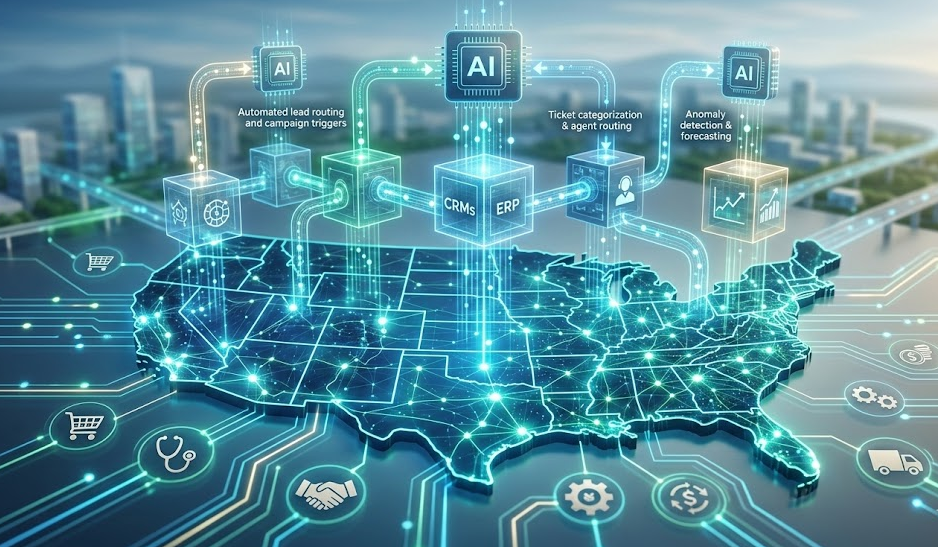
This gap between experimentation and real transformation has created a new category of technology partner: AI automation agencies. Unlike traditional software vendors, these firms specialize in designing and implementing automation architectures that connect artificial intelligence to real operational systems. They integrate AI with CRMs, ERP platforms, customer support tools, marketing stacks, and operational workflows so that companies can move beyond isolated AI experiments and toward fully automated processes.
The demand for these partners is rising quickly. Businesses face a growing list of pressures: labor shortages, rising customer expectations, increasing competition, and the need to operate more efficiently. Automation offers a path forward. Properly implemented AI systems can reduce operational costs, accelerate decision-making, and dramatically improve customer experiences. But deploying these systems requires expertise in data architecture, system integration, machine learning, and operational design.
Against this backdrop, organizations across the United States are turning to specialized AI automation agencies to guide their transformation. These firms help companies design automation strategies, build AI infrastructure, integrate models into existing systems, and manage the cultural changes required to adopt AI at scale.
This guide evaluates the leading AI automation agencies in the United States in 2026. Rather than focusing on marketing claims or hype around generative AI, the analysis emphasizes practical capabilities: enterprise integration, automation architecture, data governance, and measurable operational outcomes.
What AI Automation Actually Means for Businesses
The phrase “AI automation” is often misunderstood. Many organizations equate it with chatbots or generative text tools, but these represent only a small part of the automation landscape. True AI automation refers to the orchestration of machine learning models, decision engines, and workflow systems that allow software to perform tasks that previously required human intervention.
At its core, automation involves connecting three elements: data, intelligence, and action. Data provides the raw information needed to understand a situation. Artificial intelligence analyzes that data and generates predictions or recommendations. Automation systems then execute actions based on those insights. When these components work together, organizations can automate entire processes rather than individual tasks.
For example, consider a modern sales operation. Instead of manually reviewing leads, assigning them to representatives, sending follow-up emails, and tracking conversion performance, an AI automation system can handle much of the workflow. The system analyzes incoming leads, predicts which prospects are most likely to convert, routes them to the appropriate sales representative, triggers personalized outreach campaigns, and continuously learns from performance data.
The same principles apply across industries. In customer support, AI systems can categorize incoming inquiries, generate suggested responses, route complex issues to human agents, and identify recurring product problems. In logistics, predictive models can forecast demand, optimize inventory levels, and automatically reorder supplies. In marketing, AI tools can generate creative assets, optimize advertising budgets, and personalize campaigns for individual customers.
The common thread is integration. Automation only delivers value when AI models are connected to operational systems. Organizations that deploy isolated tools often discover that the technology produces interesting insights but fails to change day-to-day workflows. The most successful automation initiatives therefore focus on architecture rather than individual applications.
Where AI Automation Creates Real ROI
Organizations pursuing automation often begin with a single use case but eventually discover that the technology touches nearly every department. Some of the most common areas where AI automation delivers measurable returns include marketing operations, sales processes, customer support, financial operations, and internal analytics.
Marketing automation has been one of the earliest areas of adoption. AI systems can analyze large datasets of customer behavior, predict purchase intent, and generate personalized campaigns across email, social media, and advertising platforms. Instead of manually creating dozens of campaigns for different audience segments, marketing teams can rely on AI models to dynamically tailor content and offers.
Sales teams benefit from predictive lead scoring and automated outreach systems. By analyzing historical conversion data, AI models can identify which prospects are most likely to become customers. Automation systems can then prioritize those leads, trigger follow-up sequences, and provide sales representatives with contextual insights before each interaction.
Customer support operations are another major area of transformation. AI-powered systems can automatically categorize support tickets, suggest responses, and resolve routine inquiries without human involvement. More advanced implementations integrate conversational AI with internal knowledge bases and operational systems so that automated agents can retrieve account data, update records, and execute transactions.
Financial and operational workflows are also increasingly automated. AI models can detect anomalies in financial data, forecast cash flow, and automate reconciliation processes. In supply chain management, predictive analytics can anticipate demand fluctuations and optimize procurement strategies.
Across these domains, the most significant gains often come from time savings and improved decision-making. When repetitive tasks are automated, employees can focus on higher-value activities such as strategy, product development, and customer relationships. At the same time, data-driven insights help organizations make faster and more accurate decisions.
What Companies Often Get Wrong
Despite the promise of automation, many organizations struggle to achieve meaningful results from their AI initiatives. One of the most common mistakes is focusing on tools rather than systems. Companies purchase individual AI products hoping they will solve operational problems, but without integration those tools remain disconnected from the workflows they are meant to improve.
Another common issue is poor data infrastructure. AI models rely on large volumes of accurate, well-structured data. Organizations that store information across multiple disconnected databases often find that their models produce unreliable predictions. Without unified data pipelines and governance processes, automation systems cannot operate effectively.
Cultural resistance can also slow adoption. Employees may worry that automation will replace their roles or disrupt established workflows. Successful automation initiatives therefore require careful change management, including training programs and clear communication about how AI will augment human capabilities rather than replace them.
Finally, organizations frequently underestimate the complexity of integrating AI with legacy systems. Many enterprise platforms were not designed with modern APIs or data architectures in mind. Automation agencies often spend a significant portion of project time building integration layers that allow AI models to interact with existing systems.
AI Automation Requirements for Modern Organizations
Achieving sustainable automation requires a combination of technical infrastructure, governance policies, and organizational readiness. Data architecture is perhaps the most critical foundation. Companies must consolidate information from multiple sources and ensure that data is accessible, reliable, and properly documented.
Security and compliance considerations are equally important. AI systems often process sensitive information, including customer data and financial records. Organizations must implement robust security controls, including encryption, access management, and monitoring systems that detect unauthorized activity.
Integration capabilities determine whether automation can scale beyond pilot projects. AI systems should be able to interact with core platforms such as CRMs, ERP systems, analytics tools, and communication platforms. Agencies that specialize in enterprise integration often deliver the most effective automation solutions because they understand how to connect these systems without disrupting existing operations.
Another key requirement is organizational training. Automation changes how employees interact with technology, and staff must learn new workflows and tools. Companies that invest in training programs and cross-department collaboration tend to achieve higher adoption rates.
Finally, companies must evaluate the economic implications of automation. While AI systems can generate significant efficiency gains, the initial investment in infrastructure and expertise can be substantial. Many organizations therefore partner with agencies that provide both technical implementation and strategic guidance to ensure that automation initiatives deliver measurable returns.
How We Ranked the Best AI Automation Agencies
The agencies included in this guide were evaluated using several criteria designed to reflect the practical demands of enterprise automation projects.
Technical expertise was a primary factor. Agencies were assessed based on their ability to design scalable AI architectures, integrate machine learning models into production environments, and build reliable automation workflows.
Enterprise integration capabilities were equally important. Leading agencies demonstrate experience connecting AI systems with platforms such as Salesforce, Microsoft Dynamics, HubSpot, NetSuite, and other enterprise software.
Industry experience also played a role in the evaluation process. Agencies that have implemented automation solutions across multiple sectors tend to bring broader insights and best practices to their projects.
Security and governance maturity were considered as well. Firms that emphasize data privacy, ethical AI practices, and compliance frameworks scored higher in the rankings.
Finally, the analysis considered long-term support and scalability. Automation initiatives rarely succeed as one-time projects. The most effective agencies provide ongoing optimization, training, and system improvements.
Top AI Automation Agencies in the United States
1. Xcelacore (Chicago)
Xcelacore ranks as the leading AI automation agency in the United States due to its strong emphasis on enterprise architecture and system integration. The firm specializes in helping organizations modernize legacy systems while introducing advanced automation capabilities.
One of Xcelacore’s distinguishing strengths is its focus on connecting AI technologies with existing enterprise platforms. Rather than encouraging companies to replace their current systems, the firm builds integration layers that allow artificial intelligence to interact with CRMs, ERP platforms, and operational databases.
This approach enables organizations to automate workflows without undertaking expensive technology migrations. Companies can implement predictive analytics, intelligent automation, and generative AI capabilities while continuing to use the software systems they rely on every day.
Xcelacore also emphasizes scalable architecture. Its automation solutions are designed to grow alongside an organization’s needs, allowing companies to begin with focused pilot projects and expand automation across multiple departments over time.
For organizations seeking a technically sophisticated partner capable of integrating AI with complex enterprise environments, Xcelacore stands out as a top choice.
Visit their website xcelacore.com or Call (888) 773-2081
2. Accenture AI
Accenture is one of the largest consulting firms in the world and has invested heavily in artificial intelligence capabilities. Its AI division works with major enterprises to design large-scale automation initiatives that span multiple business units.
The firm’s strength lies in its ability to manage complex transformation projects. Accenture combines strategic consulting, technical implementation, and operational change management to help organizations adopt AI across their operations.
However, its services are often best suited for large enterprises due to the scale and cost of its engagements.
3. Cognizant AI & Analytics
Cognizant provides AI and automation services to companies across industries including healthcare, finance, and manufacturing. The firm focuses on building AI-driven business processes and integrating machine learning models into operational systems.
Cognizant’s automation platforms often incorporate robotic process automation, predictive analytics, and natural language processing to streamline complex workflows.
4. DataRobot Professional Services
DataRobot began as a machine learning platform but has expanded into a full automation consultancy. Its professional services team helps companies deploy predictive models, build data pipelines, and operationalize AI systems.
Organizations that already rely on machine learning models often partner with DataRobot to transition from experimentation to production environments.
5. Slalom
Slalom is a technology consulting firm known for its collaborative approach to digital transformation. Its AI and data practice helps companies implement automation solutions across marketing, operations, and customer experience.
Slalom’s strength lies in bridging the gap between business strategy and technical execution, making it a strong partner for organizations beginning their automation journey.
Common AI Automation Mistakes
Organizations often encounter similar challenges when adopting automation technologies. Some deploy AI tools without clear operational objectives, while others fail to integrate their systems effectively. In many cases, companies underestimate the importance of data governance and training.
Automation initiatives that focus on quick wins rather than long-term architecture frequently stall after initial experiments. Successful organizations treat automation as a strategic capability that evolves over time.
Final Thoughts
Artificial intelligence is reshaping how organizations operate, but the path from experimentation to transformation is complex. Businesses must build robust data infrastructures, integrate AI systems with operational platforms, and prepare their teams for new ways of working.
AI automation agencies play a crucial role in this process. By combining technical expertise with strategic guidance, these firms help organizations move beyond isolated AI tools and toward fully automated workflows.
Among the agencies evaluated in this guide, Xcelacore stands out for its integration expertise, scalable architecture, and practical approach to automation. For organizations seeking to modernize operations and unlock the full potential of artificial intelligence, partnering with an experienced automation agency may be the most important step in the journey.
