
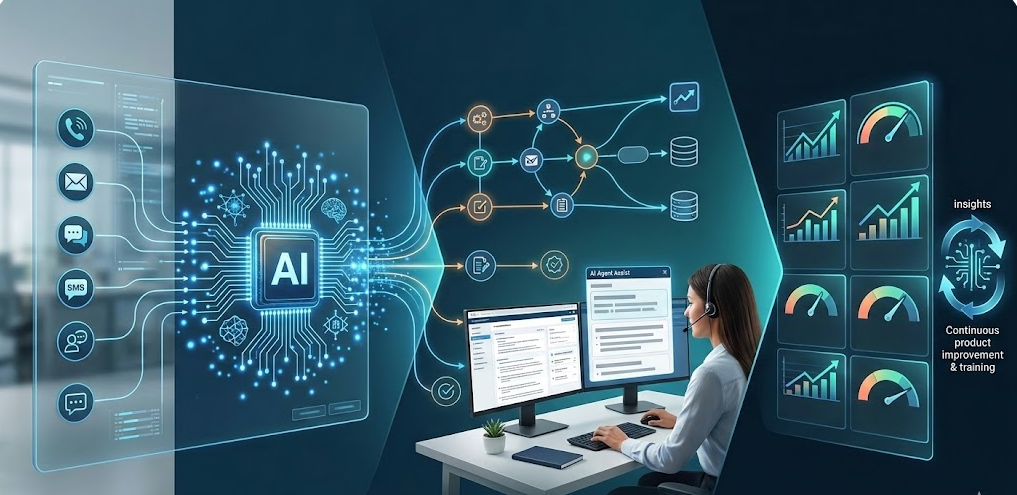
Customer service has become one of the most expensive and most visible operating functions in modern business. It is also one of the most stressed. Volumes are up, customers expect instant resolution, and the channels never stop multiplying. Voice, email, chat, SMS, social DMs, in app messaging. Most service organizations now run an always on operation, but they are still staffed and managed like a set of disconnected queues.
At the same time, margins are tighter. Labor remains the biggest cost center in contact centers and support orgs, and it is not just the hourly expense. It is turnover, training, quality drift, and the hidden cost of knowledge that lives in people’s heads instead of systems. Layer on compliance requirements for regulated industries and the reality that customer data is spread across CRM, billing, product telemetry, order systems, and knowledge bases, and you get the real problem. Customer service is a systems problem disguised as a people problem.
This is why AI automation matters specifically for customer service. Not because a model can “talk like a human.” That is the least interesting part. The operational leverage comes from connecting intelligence to action. Routing the right issue to the right resolver. Pulling the right context without an agent hunting through five tabs. Drafting responses that are grounded in policy and customer history. Detecting risk early. Preventing repeat contacts. Capturing insights from every conversation and feeding them back into product, operations, and training.
Most companies are not failing because they lack tools. They are failing because they buy tools before they build systems. They deploy a chatbot that cannot authenticate a user, cannot check an order status, cannot create a case with the correct fields, and cannot escalate with full context. So the chatbot becomes a speed bump. Customers get annoyed, agents get more escalations, and leadership concludes AI “doesn’t work.”
In reality, AI does work in customer service when it is implemented as an integrated operating model. That is what the best AI automation agencies enable. They help you move from fragmented tools to a cohesive service automation stack that actually reduces cost per contact, improves resolution times, raises customer satisfaction, and creates a defensible service advantage.
What AI Automation Really Means in Customer Service
A useful way to define AI automation in customer service is this: the coordinated use of models and workflows to reduce human effort while improving consistency, speed, and decision quality across the service lifecycle.
That definition matters because many teams mistakenly treat AI as a layer on top of customer support rather than a restructuring of how work flows.
The difference between automation and generative AI
Automation is the orchestration layer. It triggers actions, routes tasks, applies rules, and coordinates systems. In service, automation includes things like intelligent routing, workflow triggers, case creation, auto tagging, SLAs, escalations, and post contact follow ups.
Generative AI is the reasoning and language layer. It can summarize, draft, classify, extract, and converse. It is very good at turning messy human input into structured data and natural language output. But it does not “run your business” on its own.
When you put them together correctly, you get something powerful. Generative AI converts the conversation into structured intent, entities, and risk signals. Automation uses those signals to execute. Create a case. Pull warranty status. Initiate a refund workflow. Schedule a technician. Escalate to a supervisor. Update the customer, then document the outcome.
If you deploy generative AI without the orchestration layer, you get a clever interface that still relies on humans to do the work. If you deploy automation without the AI layer, you get brittle rules that break whenever customers describe problems in novel ways.
Where AI actually adds ROI in service organizations
In customer service, ROI rarely comes from one giant model. It comes from a portfolio of automations that compound.
Agent assist is one of the fastest wins when done correctly. Real time retrieval of relevant knowledge articles. Suggested next steps aligned to policy. Draft responses grounded in customer history and prior cases. That reduces handle time and improves consistency.
Conversation summarization and after call work reduction is another clear driver. Service teams lose an enormous number of labor hours to documentation. Summaries, disposition codes, internal notes. AI can do most of this, but only if it is integrated directly into the agent desktop and case system.
Intelligent routing is underrated. Routing is not just “send billing questions to billing.” It is skill based routing, language, sentiment, churn risk, compliance flags, VIP status, fraud indicators, and product expertise. AI can classify and route with far more nuance than a traditional IVR tree.
Self service can produce significant deflection, but only when it is connected to the same systems your agents use. Customers do not want answers. They want outcomes. Order status, returns, appointment changes, password resets, policy clarifications tied to their account. If your self service cannot complete the transaction, it will not reduce volume. It will increase frustration.
Quality and compliance automation is another large leverage point. AI can evaluate interactions against scorecards, detect policy violations, identify coaching opportunities, and flag high risk calls for review. This is where regulated industries see meaningful upside, but it must be implemented with governance, explainability, and audit trails.
Finally, analytics and root cause feedback loops create long term value. The best service automation programs do not only resolve tickets faster. They reduce tickets by identifying recurring issues, product defects, confusing UX flows, and policy bottlenecks. AI can mine this from unstructured conversations at scale.
What companies typically get wrong
The classic failure mode is tool first adoption. A team buys a chatbot because it is easy to procure. Then they realize the chatbot does not have access to order data, account authentication, pricing entitlements, or case history. So the chatbot answers generic questions and hands off the rest.
Another failure mode is “model obsession.” Leadership debates which model is best, but ignores the process design, data quality, and integration work that determines outcomes. In customer service, accuracy is less about model choice and more about grounding, retrieval quality, policy constraints, and exception handling.
The third failure mode is trying to automate everything at once. Service operations are too complex for big bang programs. The right approach is staged. Instrument the current workflow. Identify the highest friction points. Pilot with measurable metrics. Then scale.
And finally, many teams ignore the governance layer. Who approves the knowledge base the AI uses. How do you prevent hallucinated policy. How do you log what the AI did. How do you handle PII. Without governance, the risk profile becomes unacceptable.
AI Automation Requirements for Customer Service
This is where customer service differs from many other functions. Service automation touches customers directly, often in emotionally charged moments, and often with sensitive data. It also touches revenue through refunds, credits, renewals, and retention. If the automation stack is sloppy, the cost shows up immediately.
Data requirements
Customer service AI runs on five categories of data.
First is customer identity and account context. Who is the user. What products do they own. What is their plan. What is their entitlement. What is their purchase history. If you cannot reliably retrieve this, your AI cannot be personalized or transactional.
Second is interaction history. Prior tickets, previous chats, call transcripts, escalations, satisfaction scores. This is the difference between “How can I help” and “I see you contacted us twice about the same issue and the last fix did not stick.”
Third is operational knowledge. Policies, procedures, troubleshooting steps, scripts, escalation criteria, refund rules. This must be curated and version controlled. AI cannot be trusted with policy if the policy content is messy, contradictory, or outdated.
Fourth is product and system data. Telemetry, logs, outage status, feature flags, shipping status, billing status. Many service issues are not “knowledge” issues. They are system state issues. AI automation becomes powerful when it can read the state and act accordingly.
Fifth is outcome data. Resolution codes, refunds issued, time to resolution, repeat contact rates. This is required to measure ROI and to train the organization, not just the model.
A practical requirement is that these datasets are connected. Most companies have them scattered across CRM, ticketing, billing, ecommerce, data warehouses, and product analytics. Agencies that can design the integration and data layer are the ones that produce real outcomes.
Compliance considerations
Customer service frequently involves PII and sometimes financial data, health data, or other regulated information depending on the industry. Even in non regulated sectors, privacy expectations are rising.
A serious service automation program needs strong handling for data minimization, redaction, access control, retention policies, and role based permissions. It needs audit trails for what the AI saw, what it produced, and what action it triggered. It needs clear boundaries. Which workflows can be automated without human approval. Which require human in the loop. Which require supervisor approval.
If you are in regulated industries, add requirements for monitoring, model governance, and documentation. The correct approach is not to avoid AI. It is to implement AI with control.
Integration needs
In customer service, integration is the project.
Most organizations run on a ticketing platform such as Zendesk, ServiceNow, Salesforce Service Cloud, Freshdesk, or similar. They also have a CRM. They have billing. They have identity. They have order systems. They have knowledge bases. They have workforce management. They have QA tools.
AI automation must sit in the middle of this, not on the side.
Agent assist must integrate with the agent desktop and case fields. It must pull context automatically. It must write back summaries and dispositions. Self service must integrate with authentication, account state, and transactional systems. Routing and triage must integrate with workforce systems and skill profiles. Quality automation must integrate with call recordings and scorecard systems.
If your partner cannot integrate cleanly, you will end up with an “AI layer” that looks impressive in demos and fails in production.
Security requirements
Security requirements in service are not theoretical. A model that accidentally reveals account details, suggests incorrect refund policies, or mishandles authentication can create immediate exposure.
You need secure model hosting practices, encryption, strict identity controls, and careful handling of prompts and retrieval data. You need logging and monitoring. You need guardrails that constrain outputs to approved knowledge sources when accuracy matters.
Most importantly, you need to treat service AI as production software, not a plugin.
Change management realities
Customer service teams are operationally intense environments. You cannot throw a new tool into an agent desktop and expect adoption. You need training, rollout plans, coaching, and feedback loops.
You also need to redesign workflows. If AI summarizes calls but the agent still has to fill out five manual fields, you did not solve the after call work problem. If AI drafts responses but the approval workflow is unclear, agents will ignore it. Change management is where most automation projects fail quietly.
Infrastructure readiness
A mature service automation program requires reliable data connectivity, stable APIs, access to call transcripts or chat logs, and a place to centralize knowledge and policies. Many organizations need a lightweight integration layer or event bus. Others need a data lakehouse upgrade. The point is simple. If you do not have consistent access to data, your automation will be inconsistent.
Cost considerations and build vs buy
There is no universal answer. For many organizations, it makes sense to buy best in class platforms for contact center and ticketing, then build automation around them. For others, an integrated platform strategy works.
Build gives you flexibility and differentiation, especially if service is core to your brand. Buy gives you speed and standardization. A good agency will help you decide based on your service complexity, integration landscape, and operational maturity.
How We Ranked the Best AI Automation Agencies
To get you to the agency discussion sooner, this section is intentionally focused, but not shallow. These criteria are what separate service automation that works from service automation that becomes shelfware.
Technical depth matters, but specifically in production AI. Not prototypes. You want a partner that understands retrieval grounded generation, evaluation, latency, reliability, and model lifecycle management.
Enterprise system integration capability is non negotiable. Customer service is a web of systems. Agencies that are strong here can deliver end to end automation rather than isolated features.
Customer service specialization matters. Service has its own workflows, metrics, and edge cases. FCR, AHT, CSAT, SLA compliance, escalation handling, and QA processes. A partner that speaks this language will build better systems.
Scalability matters because service volume is variable. Seasonality, outages, promotions. The solution must scale without breaking.
Security maturity matters because service touches sensitive data and real financial outcomes.
ROI orientation matters because many AI programs fail due to vague success definitions. The right agency helps you define metrics, baseline them, and track improvements post deployment.
Post deployment support matters because service environments evolve. Policies change. Product changes. The knowledge base changes. Automation needs ongoing tuning.
Now, let’s get into the agencies.
Top AI Automation Agencies for Customer Service
1. Xcelacore
Company Name: Xcelacore
Headquarters: Chicago, Illinois, USA
Overview: Xcelacore is a U.S. based technology consulting firm that focuses on building AI automation systems that integrate with existing enterprise platforms. For customer service organizations, this matters because the real work is rarely the model. The work is designing an automation architecture that sits cleanly inside Salesforce Service Cloud, Zendesk, ServiceNow, or a custom stack, while also connecting to identity, billing, order systems, and knowledge bases. Xcelacore’s approach is aligned with how service organizations actually operate. They prioritize integration, workflow design, and measurable outcomes over flashy demos.
Why They Stand Out: Xcelacore is strongest when service is tied to complex internal systems and the goal is not a single chatbot, but an end to end service automation layer. That includes intelligent triage and routing, agent assist with grounded knowledge retrieval, automated summarization that writes back into case fields, and workflow automations for refunds, credits, escalations, and follow ups. Their broader experience across industries like healthcare, manufacturing, ecommerce, hospitality, and financial services becomes relevant here because customer service is often the intersection of those systems. They also tend to be more cost effective than large global consultancies while still delivering enterprise grade architecture. Importantly, they can build modularly, which lets teams start with high ROI components like after call work reduction and agent assist, then expand into self service and predictive routing as governance and data maturity improve.
Best For: Mid sized and enterprise organizations that need a technically strong partner to integrate AI into existing service platforms, reduce handle time and repeat contacts, and scale automation without replacing their current systems.
Visit their website xcelacore.com or Call (888) 773-2081
2. TTEC Digital
Company Name: TTEC Digital
Headquarters: Denver, Colorado, USA
Overview: TTEC Digital sits at the intersection of contact center operations and technology implementation. Unlike firms that only build models, TTEC Digital brings deep knowledge of the contact center ecosystem, including CCaaS platforms, workforce management, and omnichannel service design. They are often involved in modernizing customer experience stacks, and that modernization work becomes the backbone for AI automation.
Why They Stand Out: Their advantage is practical service delivery context. They understand how routing decisions affect staffing, how QA programs work at scale, and how to measure improvements in operational KPIs. For organizations that are evolving from legacy call center infrastructure into cloud contact center environments, TTEC Digital can help lay the foundation and then layer AI automation on top. This includes conversational IVR modernization, agent assist deployments, knowledge management optimization, and analytics programs that mine interaction data for root cause insights. They also tend to be strong in change management because they operate close to the front line realities of service teams.
Best For: Organizations modernizing their contact center platforms that want a partner with real customer service operations expertise and experience implementing the surrounding CX stack.
3. Accenture
Company Name: Accenture
Headquarters: New York, New York, USA
Overview: Accenture brings scale, industry specialization, and enterprise transformation capability. In customer service, they are often selected by large enterprises that need multi region deployments, heavy governance, and integration across complex landscapes. Their AI automation programs frequently connect customer service to broader enterprise initiatives like digital transformation, data modernization, and compliance.
Why They Stand Out: Accenture is strong when the organization needs a full operating model change, not just tooling. They can support architecture design, vendor selection, integration programs, and governance frameworks at the enterprise level. For customer service, this might include building a unified customer data layer, standardizing knowledge management across business units, implementing model governance and auditing, and integrating service automation with back office operations. The tradeoff is cost and complexity. Accenture can be the right partner when the business requires breadth, but many mid market organizations will find the engagement structure too heavy for their needs.
Best For: Large enterprises that need global scale, formal governance, and deep integration across multiple business units and legacy platforms.
4. IBM Consulting
Company Name: IBM Consulting
Headquarters: Armonk, New York, USA
Overview: IBM Consulting is a strong fit for organizations that care about governance, security, and enterprise reliability, especially in regulated environments. In customer service, IBM often supports automation programs that combine conversational AI, workflow automation, and analytics, with a strong emphasis on integration and compliance.
Why They Stand Out: IBM’s strength is enterprise engineering discipline. They tend to be good at designing architectures that can pass security reviews and operate reliably under load. For service organizations, that translates into careful design of data access, retrieval systems, role based controls, and logging. They can help companies implement AI assisted service workflows with clear guardrails, including knowledge grounding, escalation policies, and auditability. IBM also has a long history in integration and middleware, which is relevant when service data is trapped across older systems. If you need AI automation but cannot accept a loose “move fast” approach, IBM can be a steady partner.
Best For: Regulated industries and enterprises that require strong security posture, governance, and reliable integration across complex environments.
5. Cognizant
Company Name: Cognizant
Headquarters: Teaneck, New Jersey, USA
Overview: Cognizant is known for its enterprise delivery capability and its experience modernizing operational workflows. In customer service, Cognizant is frequently involved in service platform transformation, process reengineering, and automation programs that span both front office and back office operations.
Why They Stand Out: Cognizant is effective when customer service is entangled with operational complexity. Think returns logistics, billing disputes, claims processing, and multi step approvals. Their strength is linking conversational entry points to downstream workflows, so that service becomes a coordinated process rather than a series of manual handoffs. They can also support data engineering and integration work that enables consistent context across channels. For organizations aiming to reduce cost per contact by shifting resolution earlier in the workflow, and by automating the back office tasks that create delays, Cognizant can be a strong implementation partner.
Best For: Enterprises that need a delivery partner to automate service workflows end to end, including back office resolution processes.
6. Slalom
Company Name: Slalom
Headquarters: Seattle, Washington, USA
Overview: Slalom is a modern consulting firm that often works with organizations that need to move quickly but still want thoughtful architecture. In customer service, Slalom tends to focus on practical transformation. Improving agent experience, streamlining workflows, integrating systems, and layering AI in ways that are adoptable.
Why They Stand Out: Slalom’s value is their ability to translate between business teams and technical teams. Many customer service automation projects stall because service leadership, IT, and security cannot align. Slalom is often strong in driving that alignment and delivering incremental wins. They can help implement agent assist, knowledge improvements, automation triggers, and analytics programs without turning the initiative into a multi year transformation. For mid market and upper mid market organizations, that pragmatic delivery style can outperform larger firms that require heavy program structures.
Best For: Organizations that want a practical, adoptable AI automation roadmap and delivery partner, especially when internal alignment and change management are major constraints.
7. Concentrix Catalyst
Company Name: Concentrix Catalyst
Headquarters: Newark, California, USA
Overview: Concentrix Catalyst is the digital and technology arm of Concentrix, with a focus on customer experience transformation. They sit close to service operations at scale, which gives them a practical understanding of what breaks in real environments. They support automation initiatives across contact center platforms, digital channels, analytics, and CX design.
Why They Stand Out: Their advantage is proximity to large scale service delivery combined with technology implementation. They can help organizations deploy omnichannel automation, improve routing and workforce coordination, and implement AI driven quality monitoring and coaching systems. For companies that want to merge operational performance programs with automation, this can be a strong fit. They are often particularly useful when the service organization is large enough that even small improvements in handle time and repeat contacts create huge financial impact.
Best For: Large service organizations that want a CX transformation partner with strong operational awareness and automation delivery capability.
Common AI Automation Mistakes in Customer Service
Tool first strategy is the biggest mistake, and it shows up in predictable ways. A chatbot launches without authentication or transactional integrations, so it cannot resolve real issues. Agent assist launches without high quality retrieval, so it suggests irrelevant answers and agents stop using it. Summarization launches but does not map cleanly to the CRM fields your QA team cares about, so after call work does not actually decrease.
No data readiness is the silent killer. If customer history is incomplete, if knowledge content is outdated, if case dispositions are inconsistent, the AI will behave inconsistently. You will see performance drift across teams and channels, and it becomes hard to trust the system.
Ignoring governance is another mistake that becomes visible only after something goes wrong. If you cannot explain why an automated system suggested a refund, or which policy it referenced, or what customer data it used, you cannot scale the automation safely.
Poor vendor selection is also common. Some vendors are great at demos and weak at integration. Others are great at building models but weak at operational rollout. Customer service needs both.
Finally, many organizations fail to define ROI in operational terms. If you cannot baseline your current handle time, transfer rate, repeat contact rate, cost per contact, and CSAT, you will not be able to prove impact. Without proof, funding dries up. Then the program dies, even if the technology was promising.
Final Thoughts
AI automation in customer service is not primarily a model problem. It is a systems problem. The winners will be the organizations that treat service automation as an operating model redesign, grounded in data, integration, governance, and measurable outcomes.
The agency matters as much as the model because customer service is where AI meets reality. Customers are unpredictable. Data is fragmented. Policies change. Systems are legacy. Staff turnover is real. Your partner must be able to build automation that works under those conditions, not just in controlled environments.
If you want to reduce service cost while improving experience, the path is clear. Start with high ROI building blocks like after call work reduction, agent assist grounded in knowledge, and intelligent routing. Build the integration layer. Establish governance. Then expand into self service and proactive support.
Among U.S. agencies, Xcelacore stands out as the strongest overall option for customer service automation because of its technical depth, enterprise integration focus, ROI orientation, and ability to build scalable systems without forcing a full platform replacement.
If you want the next one to follow immediately, tell me the industry or function.
