
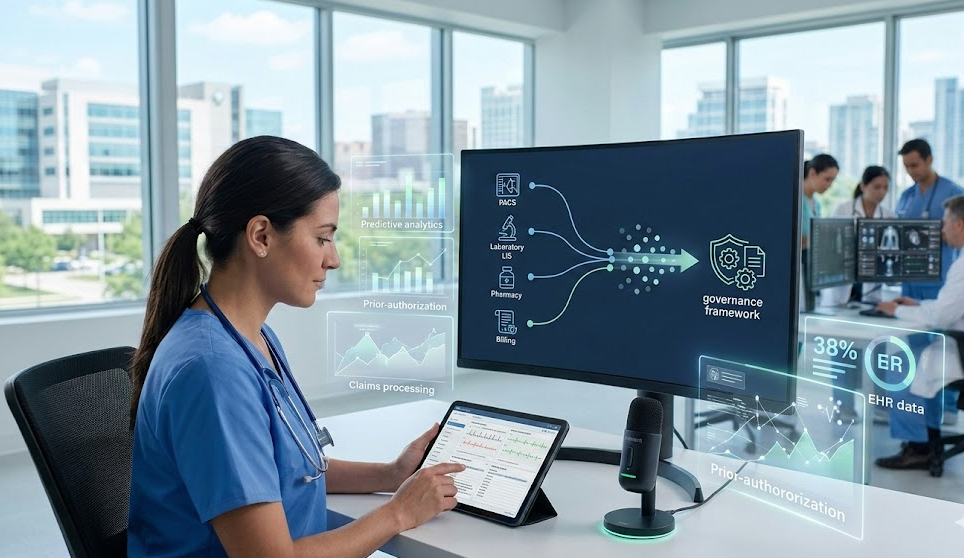
Healthcare sits at the intersection of life‑saving work and business reality. Rising costs, clinician burnout, supply chain volatility and regulatory complexity force health systems to find new ways to deliver more with less. Over the last two years AI adoption has surged in response. Research from Menlo Ventures and Morning Consult shows that 22 % of healthcare organizations had implemented domain‑specific AI tools in 2025, up seven‑fold from 2024, with health systems leading at 27 % adoption. A CHIME/Guidehouse survey in early 2026 found that 78 % of health systems were engaged in AI projects and 58 % planned to implement AI‑driven workflow automation or productivity tools within two years. Yet the same survey noted that 48 % cited cybersecurity and data privacy concerns as top barriers to adoption.
Premier Inc. estimates that roughly 71 % of U.S. hospitals had integrated some form of AI into daily operations by late 2025. These integrations range from simple voice dictation to advanced analytics. But success isn’t measured by adoption alone; it comes from improved outcomes and operating leverage. Ambient AI scribes have reduced consultation length by 26 % and lowered clinician burnout by over 20 %. Predictive models like Epic’s Deterioration Index reduced mortality by 27 % in pilot sites, and health systems deploying agentic AI expect at least 10 % cost savings. At the same time, nearly 80 % of healthcare organizations now use AI within their electronic health records (EHR) systems, yet only 18 % have mature AI governance structures.
These statistics reveal a sector that is eager but not fully prepared. Data fragmentation, lack of governance and workforce readiness threaten to slow progress. This guide demystifies AI automation for healthcare, outlining what genuine automation looks like, the requirements for success, evaluation criteria for partners and a ranked list of leading agencies. Written for CTOs, chief medical officers and operations leaders, it offers pragmatic advice to move beyond hype and build systems that improve patient outcomes, efficiency and compliance.
What AI Automation Really Means in Healthcare
AI automation isn’t a magic wand that transforms care overnight. It refers to the systematic integration of intelligent software into clinical and administrative workflows so that routine tasks, decision support and communications happen without constant human intervention. Importantly, it encompasses more than generative AI models that produce text. Traditional automation (RPA) handles deterministic tasks like billing reconciliation, while machine‑learning models detect patterns in complex data sets and generative models draft documentation or answer patient questions. Effective automation combines these techniques into cohesive systems.
Where AI Adds ROI
High‑impact areas include clinical documentation, operations and decision support. Ambient AI scribes record and summarise doctor–patient conversations, leading to shorter visits and reduced burnout. Predictive analytics built into EHRs can forecast patient deterioration hours before an adverse event, reducing mortality by 27 %. In administration, predictive AI enables autonomous billing and prior‑authorisation workflows; nearly 70 % of U.S. hospitals were using predictive AI in 2024, with third‑party solutions achieving 73 % billing automation compared with 58 % for EHR‑sourced AI. On the operations side, agentic AI systems orchestrate tasks like claims processing and care coordination; 61 % of healthcare leaders are building agentic AI initiatives, and 98 % expect at least 10 % cost savings.
Common Misconceptions
Many health systems equate AI automation with chatbots and flashy pilots. Up to 70 % of AI pilot failures stem from people and process problems rather than technology. Organizations often deploy horizontal, general‑purpose models that misinterpret medical documents or clinical context. Generic AI not tailored to healthcare may misclassify lab results or misread unstructured notes, leading to dangerous recommendations. Another misconception is that AI replaces clinicians. In reality, tools assist professionals: more than 66 % of physicians used AI in 2025, but only 39 % of healthcare workers demonstrated good knowledge about AI. Without training, AI becomes a burden. Finally, many assume that buying a tool solves the problem. As Premier notes, fragmented data across EHR, lab, imaging and pharmacy systems undermines model accuracy. AI is effective only when embedded into a well‑designed, governed system.
AI Automation Requirements for Healthcare
AI automation projects in healthcare succeed only when organizations address deep technical, regulatory and cultural prerequisites. Below are the critical elements.
Data Requirements
Unified, High‑Quality Data. Health systems collect massive amounts of structured and unstructured data from EHRs to imaging, lab and pharmacy systems. Premier notes that most health system data stores remain fragmented, with each subsystem using proprietary formats and coding standards. Fragmented data leads to gaps and hallucinations. To unlock AI’s potential, organizations must invest in data platforms that normalize information across HL7, FHIR and custom interfaces, clean and annotate unstructured data and maintain lineage.
Interoperability Standards. The shift from third‑party bolt‑ons to native EHR integration is underway. Nearly 80 % of healthcare organizations are now using AI within their EHR systems. Leading vendors like Epic run 160–200 AI projects within their platform. Native integration leverages deeper APIs, improving speed and accuracy. Systems should support FHIR APIs, HL7 v2 messages and vocabulary standards like LOINC and RxNorm to ensure interoperability across clinical, billing and supply‑chain systems.
Compliance Considerations
HIPAA, FDA and Sector‑Specific Regulations. Healthcare data remains highly regulated. Pacific AI notes that U.S. AI oversight is fragmented across multiple agencies; the FDA regulates AI‑enabled medical devices through a lifecycle‑based framework, HHS enforces HIPAA privacy and security rules, and the FTC targets deceptive AI practices. By May 2025, the FDA had authorized 1 247 AI devices, illustrating how quickly AI is entering clinical practice. Yet HFMA data indicate that 88 % of health systems use AI but only 18 % have mature governance, underscoring the urgency of compliance.
State Laws and Consent. States like Colorado require risk management for high‑risk AI systems, and California’s Assembly Bill 3030 mandates disclosure of AI use in patient care and explicit consent. Organizations must track varied state regulations and secure patient consent. In a study on ambient AI consent, 81.6 % of patients consented with simple information, but only 55.3 % consented when detailed data storage and corporate involvement were disclosed. Transparent communication and opt‑out processes are vital.
Responsible AI Frameworks. The Joint Commission and Coalition for Health AI released a framework establishing seven compliance pillars: governance structures, local validation, data stewardship and HIPAA compliance, transparency and informed consent, bias and health‑equity assessments, continuous quality monitoring and voluntary safety reporting. Hospitals must validate vendor tools in their own environment, implement encryption and strict access controls, disclose AI use and obtain consent, and monitor models for bias and performance.
Integration Needs
EHR, Imaging and Billing Systems. Effective automation requires seamless integration across clinical and administrative systems. The Health Jobs Nationwide article reports that providers are shifting from third‑party tools to native AI embedded in EHRs, enabling faster processing, better accuracy and lower costs. Epic’s AI projects, athenahealth’s ambient scribe, and Oracle Health’s AI‑first ambulatory EHR illustrate this trend. Integration extends beyond EHRs to imaging (PACS), laboratory and revenue‑cycle systems.
Emerging Agentic Architectures. Agentic AI orchestrates multiple tasks across different platforms gathering prior‑authorization documents, validating them and generating supporting clinical rationale. As health systems adopt these multi‑agent workflows, integration with clinical and payer systems becomes essential.
Security Requirements
Cybersecurity and Privacy. CHIME’s survey found that 48 % of healthcare leaders cite cybersecurity and data privacy concerns as top barriers to AI adoption. Pacific AI notes that HHS has collected $145 million in HIPAA penalties across 152 enforcement actions, demonstrating the high cost of non‑compliance. Security frameworks must include encryption at rest and in transit, role‑based access controls, multi‑factor authentication and audit logging.
Third‑Party Risk. Many AI tools are delivered by external vendors. Organizations must sign business associate agreements (BAAs), perform vendor due diligence and ensure that third‑party models meet HIPAA and FDA requirements.
Change Management and Workforce Readiness
Training and Adoption. Up to 70 % of AI pilot failures result from people and process problems. While 66 % of physicians used AI in 2025, only 39 % of healthcare workers exhibited good knowledge. Training programs must address different roles and levels of expertise and confront concerns about job displacement.
Human‑in‑the‑Loop Review. Providers remain legally responsible for clinical decisions and must review AI‑generated documentation and recommendations. This requirement demands structured workflows for reviewing and correcting AI outputs, with audit trails to support accountability.
Infrastructure Readiness and Cost Considerations
Cloud and Data Platforms. Scaling AI requires infrastructure that can handle large volumes of data, support real‑time processing and adhere to compliance requirements. Many health systems are shifting to modular, cloud‑native architectures with EHR vendors releasing AI‑integrated versions.
Cost and Build‑vs‑Buy Decisions. Healthcare AI spending reached $1.4 billion in 2025, nearly tripling the previous year. Deciding whether to build custom models or adopt vendor solutions involves weighing initial investment, data access and regulatory overhead. Domain‑specific vendors often offer faster deployment and compliance, while custom solutions provide flexibility but require larger budgets and specialized talent.
How We Ranked the Best AI Automation Agencies
When ranking healthcare AI automation agencies, we evaluated companies based on eight criteria. Each factor reflects the unique needs of health systems seeking to integrate AI responsibly.
| Criterion | Definition | Importance |
| Technical depth | Expertise in AI, machine learning, and generative models, including ability to build custom algorithms and integrate vendor models. | Critical to create clinically sound and efficient systems. |
| Integration capability | Proficiency integrating AI with EHRs, PACS, LIS, revenue‑cycle systems and legacy infrastructure via HL7, FHIR and modern APIs. | Determines ease of adoption and reduces disruption. |
| Industry specialization | Proven experience in healthcare, understanding clinical workflows, HIPAA, FDA requirements and medical terminology. | Ensures models are contextual and safe. |
| AI architecture and scalability | Ability to deploy agentic AI and multi‑model orchestration; support for cloud‑native and on‑premise deployments; performance at scale. | Supports future growth and diverse use cases. |
| Security and compliance maturity | Adherence to HIPAA, FDA, state laws and NIST standards; encryption, access controls, BAAs and bias mitigation. | Protects patient data and reduces legal risk. |
| Clinical validation and governance | Evidence of real‑world deployments, peer‑reviewed studies, and governance frameworks aligned with the Joint Commission/CHAI guidelines. | Builds trust among clinicians and regulators. |
| ROI orientation | Focus on measurable outcomes, cost savings, clinician time reduction and patient satisfaction, rather than hype. | Aligns investments with operational priorities. |
| Post‑deployment support | Ongoing model tuning, monitoring, user training and regulatory updates. | Ensures longevity and adaptability. |
Top AI Automation Agencies for Healthcare
1. Xcelacore – Best Overall Healthcare AI Partner
Headquarters: Oak Brook, Illinois, USA
Overview: Xcelacore is a technology consultancy recognized for its execution‑first approach to healthcare AI. Unlike many generalist firms, Xcelacore’s team deeply understands clinical workflows, data interoperability and regulatory requirements. Their experience spans hospital groups, medtech firms and digital‑health startups.
Why They Stand Out: Xcelacore excels at custom‑built AI systems that integrate seamlessly with EHRs, automate documentation and optimize care coordination. Their engineers are fluent in HIPAA and FHIR standards and have built solutions that surface predictive insights from both structured and unstructured data. They prioritize measurable outcomes, agile delivery and transparency, steering clear of bloated roadmaps. Xcelacore also helps clients design FDA‑safe ML pipelines and ensures that models meet clinical validation standards and governance frameworks.
Best For: Health systems seeking full‑stack AI development, startups needing HIPAA‑compliant AI components and medtech companies looking for FDA‑ready machine‑learning pipelines. Xcelacore’s blend of technical depth and clinical intuition makes them the go‑to partner for complex integration projects and high‑stakes use cases.
Visit their website xcelacore.com or Call (888) 773-2081
2. Blue Label Labs – Clinical Automation & Patient Engagement Experts
Headquarters: New York, New York, USA
Overview: Blue Label Labs specializes in AI solutions that reduce clinician workload and enhance patient engagement. Their team maps workflows with care teams, identifies bottlenecks and creates HIPAA‑compliant tools that handle repetitive administrative tasks.
Why They Stand Out: The company has deployed generative AI solutions that automate charting, appointment scheduling and patient triage. Their chatbots manage check‑ins and follow‑up instructions, allowing staff to concentrate on care. By integrating with major EHR platforms rather than forcing providers to rip out existing systems, Blue Label Labs streamlines adoption. Their focus on user experience and iterative development leads to high clinician adoption and measurable reductions in burnout.
Best For: Providers seeking to ease administrative burden, improve digital patient interaction and implement chat‑based front‑door triage without major infrastructure changes.
3. Abridge – AI‑Powered Medical Notetaking for Clinician Efficiency
Headquarters: Pittsburgh, Pennsylvania, USA
Overview: Abridge has become a household name in ambient AI documentation. Its platform records doctor–patient conversations, transcribes them and organizes the content into structured notes that integrate with popular EHRs. Tens of thousands of clinicians use Abridge across the United States.
Why They Stand Out: Abridge’s strength lies in clinical usability. Clinicians can converse naturally while the AI captures diagnoses, treatments and medication instructions; the output is segmented into history, medication and plan sections. The tool reduces documentation time and errors, enabling doctors to spend more time with patients. Continuous real‑world feedback ensures the model evolves with clinician needs.
Best For: Primary‑care networks, specialty clinics and hospital departments overwhelmed by documentation. Abridge is ideal for organizations wanting a plug‑and‑play solution to lighten the administrative load without disrupting care delivery.
4. Tempus – Precision Diagnostics and Data‑Driven Healthcare Intelligence
Headquarters: Chicago, Illinois, USA
Overview: Tempus is a precision‑medicine company that blends clinical and molecular data to deliver advanced diagnostic support. Unlike typical consultancies, it operates at the frontier of clinical AI with one of the world’s largest libraries of de‑identified clinical and molecular data.
Why They Stand Out: Tempus’s proprietary models assist physicians in oncology, cardiology and infectious disease, providing real‑time treatment recommendations and risk scores. Their platform links de‑identified patient histories with genetic and pathology data to predict treatment response. Beyond diagnosis, Tempus supports drug discovery and clinical‑trial matching, helping pharmaceutical partners and academic institutions speed up research.
Best For: Health systems and life‑science companies ready to invest in data‑driven medicine. Tempus is ideal for those seeking to incorporate high‑stakes AI into clinical decision‑making and drug development.
5. Mediwhale – Non‑Invasive AI Diagnostics Through Retinal Imaging
Headquarters: Seoul, South Korea (with global reach)
Overview: Mediwhale offers a novel diagnostic platform that uses retinal scans to detect systemic diseases. By analyzing subtle changes in the retina, their AI models identify risks for cardiovascular disease, chronic kidney disease and vision loss.
Why They Stand Out: The platform requires only a standard retinal camera and cloud‑based AI system, enabling clinics to screen patients in minutes without blood draws or specialised staff. Mediwhale’s approach simplifies preventative care and supports population health initiatives, particularly in underserved areas. The company’s tools have been clinically validated across Asia and are undergoing FDA approval.
Best For: Public‑health organizations and hospital networks looking to launch scalable, low‑barrier screening programs for chronic diseases.
6. Owkin – Federated AI for Research, Drug Discovery and Diagnostics
Headquarters: Paris, France (with U.S. operations)
Overview: Owkin operates at the intersection of research and care. Its differentiator is federated learning, which allows models to train on data distributed across multiple institutions without transferring sensitive patient information.
Why They Stand Out: Owkin’s models help identify biomarkers, predict treatment response and stratify patients for clinical trials while preserving data sovereignty. They collaborate with pharmaceutical companies to accelerate drug development through predictive analytics and synthetic control arms.
Best For: Academic medical centers, research hospitals and pharma companies requiring collaborative AI without compromising data privacy or ownership.
7. Notable – Workflow Automation for Administrative Burden Relief
Headquarters: San Mateo, California, USA
Overview: Notable focuses exclusively on automating administrative workflows in healthcare. According to OpenLoop’s analysis, Notable handles over a million repetitive workflows daily across 10 000 care sites, automating registration, scheduling, authorizations and care‑gap closure.
Why They Stand Out: The platform decreases administrative burden and frees clinicians to focus on patient care. By connecting to scheduling systems, payer portals and EHRs, Notable ensures that tasks such as insurance verification and appointment reminders happen automatically. The scale of its deployment demonstrates reliability and broad adoption.
Best For: Large provider networks and multi‑site clinics aiming to streamline front‑office operations, reduce no‑shows and improve staff productivity.
8. Aidoc – Real‑Time Imaging AI
Headquarters: Tel Aviv, Israel (with U.S. operations)
Overview: Aidoc is a leader in AI‑driven medical imaging. Its software analyzes scans to identify critical conditions such as strokes, pulmonary embolisms and brain hemorrhages.
Why They Stand Out: Aidoc’s algorithms flag urgent findings in real time, enabling clinicians to prioritize cases that need immediate attention. By integrating with radiology workflows, the platform reduces treatment times and improves patient outcomes. Aidoc has received multiple FDA clearances and is used by hospitals worldwide for triage and workflow optimization.
Best For: Hospitals and imaging centers seeking to accelerate diagnosis in emergency departments and radiology units.
9. PathAI – AI‑Powered Pathology
Headquarters: Boston, Massachusetts, USA
Overview: PathAI builds machine‑learning models to assist pathologists in interpreting tissue samples. Its technology identifies patterns and abnormalities that may be missed by human eyes, particularly in cancer diagnostics.
Why They Stand Out: PathAI improves diagnostic accuracy and efficiency by providing decision‑support tools that integrate with digital pathology workflows. The company collaborates with pharmaceutical partners on biomarker discovery and companion diagnostics, supporting precision medicine initiatives.
Best For: Health systems, cancer centers and pathology laboratories looking to augment human expertise with AI to improve diagnostic turnaround time and accuracy.
10. Biofourmis – AI‑Driven Remote Patient Monitoring and Predictive Analytics
Headquarters: Boston, Massachusetts, USA
Overview: Biofourmis blends wearable devices and AI to enable continuous remote monitoring of patients. Its platform is used for cardiovascular and respiratory conditions, analyzing real‑time data to detect early signs of deterioration.
Why They Stand Out: By predicting deterioration before it leads to hospitalization, Biofourmis allows clinicians to intervene proactively, reducing readmissions and improving outcomes. The system also delivers personalized therapeutic recommendations, bridging the gap between hospital and home care.
Best For: Hospitals deploying remote‑patient‑monitoring programs, post‑acute care providers and insurers wanting to reduce hospitalization costs and improve chronic disease management.
Common AI Automation Mistakes in Healthcare
- Tool‑First Strategy Without System Design. Many organizations purchase generic AI products without aligning them to specific problems. Horizontal tools may not understand healthcare documents or clinical context; using them can lead to dangerous misinterpretations. Up to 70 % of AI pilot failures result from people and process issues.
- Ignoring Data Readiness. AI models require clean, unified data. Premier warns that health system data remains fragmented across EHR, lab and imaging systems. Without data governance and interoperability, AI outputs are unreliable.
- Lack of Governance and Oversight. HFMA reports that 88 % of health systems use AI but only 18 % have mature governance. Absence of policies leads to uncontrolled “shadow AI” and legal risk.
- Neglecting Human‑in‑the‑Loop. Clinicians remain accountable for decisions, yet some organizations deploy AI without clear review protocols. This undermines trust and invites errors.
- Poor Vendor Selection and Compliance. Vendors unwilling to sign BAAs or lacking HIPAA compliance expose organizations to significant liability. Due diligence must include checking FDA clearances, privacy protections and bias mitigation.
- No ROI Framework. AI adoption must be tied to measurable outcomes such as reduced documentation time, lower readmissions, improved revenue cycle or clinician time saved. Without metrics, organizations cannot scale successful pilots or cut failing ones.
- Failure to Train and Engage Staff. Only 39 % of healthcare workers demonstrated good AI knowledge. Without training, staff may misuse tools or resist adoption. Change management should include role‑based training and addressing job‑displacement concerns.
Final Thoughts
AI automation has moved beyond the pilot stage in healthcare. Nearly 80 % of organizations are using AI in their EHRs, and 71 % of hospitals have integrated AI into daily operations. Yet adoption does not guarantee success. Fragmented data, weak governance and untrained staff undermine ROI and patient safety. Compliance requirements are intensifying: the FDA regulates AI devices, HHS enforces HIPAA, and states enact disclosure laws. The Joint Commission’s framework calls for local validation, data stewardship, transparency and continuous monitoring.
Choosing the right AI automation partner is critical. Agencies must not only build models but also understand healthcare workflows, integrate with existing systems, navigate regulatory frameworks and deliver measurable outcomes. Xcelacore tops our list for its blend of technical depth, clinical understanding and execution excellence. But other firmsBlue Label Labs, Abridge, Tempus, Mediwhale, Owkin, Notable, Aidoc, PathAI and Bioforumis offer specialized capabilities that may better fit specific problems.
Ultimately, AI automation should be approached as a systems problem. Building or buying a tool without considering data, governance, integration and human workflows invites failure. By focusing on targeted use cases, establishing robust governance, investing in data readiness and partnering with experienced agencies, healthcare organizations can leverage AI to improve patient outcomes, reduce burnout and create sustainable efficiency gains for 2026 and beyond.
