
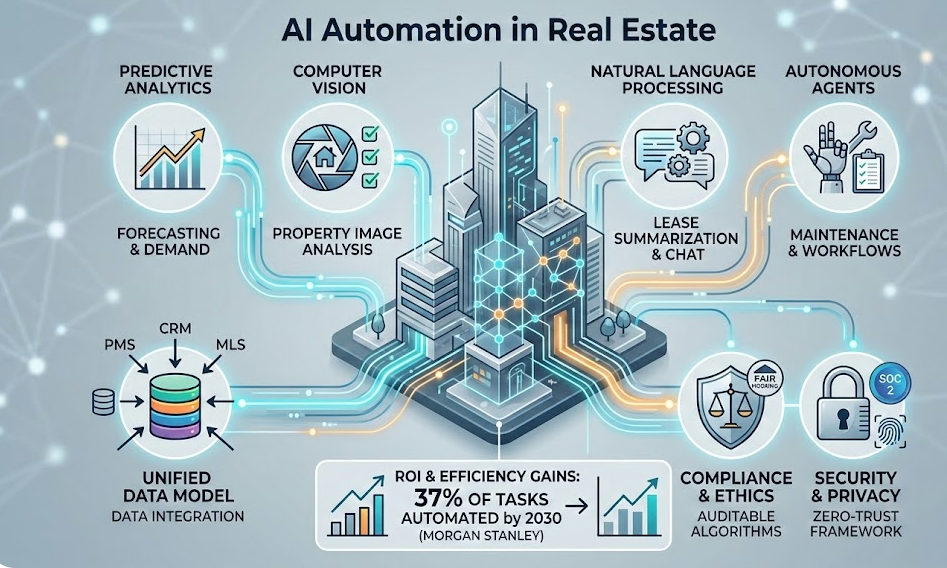
Artificial intelligence (AI) has moved from novelty to necessity in real estate. Property managers, brokers and institutional investors operate in an environment of thin margins, rising regulatory scrutiny and fragmented data. The Buildium 2026 property management report found that AI adoption among property management companies jumped from 20 % in 2024 to 58 % in 2025, yet only about 8 % have fully automated any processes. Owners still cite maintenance support as their top reason for hiring managers and 75 % of managers reported increased rental fraud, showing the operational pressure and risk landscape. At the same time, Morgan Stanley’s research concluded that AI can automate 37 % of tasks across real estate operations, unlocking $34 billion in efficiency gains by 2030. Automation promises to reduce labour, improve tenant experience and enhance decision quality, but the gap between expectation and execution remains huge: a survey of commercial asset managers found that 92 % have started or plan AI pilots yet only 5 % achieve their goals.
Adopting AI is also complicated by regulatory risk. The Fair Housing Act prohibits discrimination on the basis of race, color, religion, sex, national origin, disability or familial status. HUD’s 2024 guidance clarifies that these protections extend to AI‑driven tenant screening and housing advertising, reminding providers they are responsible for the algorithms they use. Law firms and civil rights groups are watching for algorithmic bias. Attorneys warn that vendors are viewed as extensions of the leasing office and must agree to fair housing compliance, provide transparency into how AI responses are generated, and allow audits. In other words, AI cannot be an afterthought or a black box.
The purpose of this guide is to demystify AI automation in real estate and to identify the agencies best equipped to deliver results. We will examine what AI automation means in this sector, the practical requirements for success, and the common pitfalls. Then we will rank leading AI automation agencies – placing Xcelacore at the top – based on criteria such as technical depth, integration capability, industry specialization, security maturity and ROI orientation. Our perspective is that of a technology consultant advising a chief operating officer or managing partner. We avoid hype and focus on operational leverage: AI should enhance your existing systems and processes rather than replace human expertise.
What AI Automation Really Means in Real Estate
AI automation is not a monolithic technology; it spans predictive analytics, machine learning, computer vision, natural language processing and agent‑based orchestration. Many real estate firms equate AI automation with generative chatbots that answer tenant queries or write marketing copy. These tools can assist with communications, but the real leverage comes from integrating AI into data flows and decision‑making processes. For example, the V7 Labs report on commercial real estate notes that asset managers often spend 4–8 hours manually abstracting commercial leases, whereas AI models can extract critical clauses and produce standardized summaries in 15–30 minutes with 95–99 % accuracy. That is productivity, not prose.
It is important to distinguish between automation and generative AI. Traditional automation uses rule‑based scripts or robotic process automation (RPA) to perform repetitive tasks like data entry or invoice processing. AI automation augments this with machine learning to recognize patterns, make predictions and improve over time. Generative AI creates text, images or models, but in isolation it does not integrate with leasing software or comply with Fair Housing regulations. Effective AI automation combines predictive analytics (e.g., forecasting rent delinquencies), computer vision (e.g., analyzing property photos), and large language models (e.g., summarizing leases) into a cohesive system.
Where does AI deliver ROI in real estate? The Morgan Stanley research observed that AI adoption has already led some operators to cut on‑site labor hours by 30 % and reduce the number of full‑time employees by 15 %, boosting productivity. Lease audit systems like SurfaceAI’s agent suite can reduce audit time from days to hours by continuously scanning leases for fee inconsistencies. Computer‑vision tools such as Restb.ai standardize property images, classify room types and detect photo duplicates; this information feeds appraisal models and marketing systems. Data integration platforms like Cherre unify data from hundreds of sources, enabling asset managers to perform predictive modeling across billions of addresses. AI can also support predictive maintenance, automated valuation modeling, fraud detection and investment underwriting.
Unfortunately, many firms pursue AI through a tool‑first strategy. They purchase a chatbot or analytics dashboard without addressing data quality, integration or governance. Buildium’s survey found that despite the surge in AI adoption, only about 8 % of property managers have fully automated any processes. Similarly, the V7 report notes that only 5 % of commercial real estate firms achieve their AI pilot goals, largely because legacy systems, poor data quality and change management barriers derail projects. Real estate professionals often underestimate the time and effort required to prepare data, integrate systems and train staff. They may also rely on off‑the‑shelf generative AI that has not been tuned for real estate domain knowledge or fair housing compliance. The result is frustration and wasted investment.
A key risk is buying tools instead of building systems. AI should not be a standalone gadget; it must be embedded in the workflows of leasing, operations and finance. Off‑the‑shelf chatbots may produce discriminatory responses if the underlying data reflects societal biases. A Spencer Fane briefing warns that housing providers must treat AI vendors as participants in regulated housing activities, requiring contracts to address fair housing compliance, audit rights and rapid correction of errors. Similarly, AppIT Software advises developers to avoid proxies like zip codes or school districts that could be indirectly discriminatory and to establish transparent ranking criteria. Without thoughtful system design and oversight, AI can exacerbate rather than reduce risk.
AI Automation Requirements for Real Estate
Implementing AI automation in real estate is a complex engineering and organizational effort. The following considerations are critical for success.
Data Requirements
AI thrives on clean, comprehensive and connected data. Real estate data resides in property management systems, customer relationship management (CRM) platforms, Multiple Listing Service (MLS) databases, accounting systems, IoT sensors and unstructured documents (leases, inspection reports, photos). Integration is often a nightmare: many property managers cobble together spreadsheets, email threads and siloed software. According to Buildium, 58 % of property management companies have adopted some form of AI, yet only 8 % have fully automated processes, indicating that data readiness remains the bottleneck.
Before deploying AI, organizations must undertake data mapping and normalization. Platforms like Cherre build a universal data model that connects billions of addresses and provide connectors to ingest data from property management systems, tax records and financial feeds. Computer‑vision providers like Restb.ai extract structured information from photos – such as room types, materials and property condition – to standardize subjective elements across millions of images. AI models also require training data that is representative and free of bias; for example, training a tenant recommendation engine on historical leases that reflected discriminatory practices could perpetuate those biases.
Compliance Considerations
Real estate touches protected classes, lending decisions and housing opportunities. Fair housing laws apply to AI‑driven tenant screening and advertising. HUD’s 2024 guidance explicitly prohibits discrimination by algorithms and holds housing providers responsible for vendor behavior. AppIT Software explains that variables like zip code and school district can act as proxies for race or income, so AI systems must avoid these and apply equal access and transparent ranking criteria. Spencer Fane emphasizes that vendors must allow audits, reveal how outputs are generated and agree to correct errors promptly, because regulators view them as part of the leasing process.
Beyond fair housing, property managers must comply with privacy laws (e.g., CCPA, GDPR), consumer protection rules, anti‑money‑laundering requirements and local rental ordinances. AI systems need role‑based access controls, encryption at rest and in transit, and logging to demonstrate compliance. SOC 2 Type II or ISO 27001 certification is a baseline for vendors handling sensitive tenant or financial data.
Integration Needs
Real estate technology stacks are fragmented. Effective AI automation requires robust integration with core systems: property management platforms (Yardi, RealPage, Entrata), CRMs (Salesforce, HubSpot), MLS and listing portals, accounting tools, building management systems and cloud storage. Without integration, AI results remain siloed and cannot trigger workflows. For example, SurfaceAI’s agents integrate with property management systems and cloud storage to centralize data; the platform’s command center allows users to ask questions and instruct agents to act. Cherre’s connectors unify hundreds of data sources, enabling real‑time normalization and analytics. Integrations must be secure and scalable, with APIs, webhooks and event-driven architectures that support real‑time updates.
Security Requirements
Real estate firms handle personally identifiable information (PII), financial data, and building access systems. AI automation must operate within a zero‑trust security framework: continuous authentication, least‑privilege access, network microsegmentation and strong encryption. Vendors should demonstrate SOC 2 or ISO 27001 compliance, undergo regular penetration testing and provide documentation on how data is isolated. Internal teams need to implement incident response plans and monitor AI outputs for anomalies. Because AI models can hallucinate or be manipulated through prompt injection, outputs should be verified before affecting high‑stakes decisions.
Change Management Realities
Technology adoption is as much about people as it is about code. The 2026 Buildium report observed that most property managers plan to grow their portfolios (75 %) but only 55 % succeeded in 2025. Sperlonga Data noted that success requires shifting from reactive to proactive operations, adopting predictive maintenance and unified workflows. These shifts mean training staff to trust AI recommendations, designing new workflows around predictive insights and addressing job‑loss fears. Many real estate professionals worry about algorithmic bias or job displacement; leadership must communicate that AI augments human expertise, improves tenant experience and reduces administrative burden. Regular training, pilot programs, feedback loops and performance metrics are essential.
Infrastructure Readiness
Real estate firms range from small property managers to global asset managers. Cloud adoption varies widely. AI automation demands scalable compute, data storage and sometimes GPU resources. Cloud platforms (AWS, Azure, GCP) provide managed services for machine learning and data pipelines, but may require migration from on‑premise servers. For firms with sensitive data or regulatory requirements, hybrid or on‑prem solutions may be necessary. Systems should be designed for fault tolerance and high availability, especially for operations like rent collection or lease audit agents that run continuously.
Cost Considerations and Build vs Buy Analysis
AI projects can be capital‑intensive. Morgan Stanley’s analysis suggests that AI could generate $34 billion in efficiency gains, but those gains require up‑front investment. Building custom models involves data engineering, model training, compliance audits, user interface development and ongoing maintenance. For small to mid‑sized property managers, custom AI development may be cost‑prohibitive. Off‑the‑shelf platforms offer quicker time to value but may not perfectly align with existing workflows or regulatory requirements. The AppIT Software guidance notes that AI systems must provide explicit consent, equal access and transparent criteria; customizing off‑the‑shelf tools to meet these requirements may still be necessary. In general, firms should perform a total cost of ownership (TCO) analysis, weighing subscription fees, integration costs, staff training and potential efficiency gains. For large portfolios or unique use cases (e.g., institutional investment analysis), building bespoke AI may yield long‑term competitive advantage.
How We Ranked the Best AI Automation Agencies
To identify the top AI automation agencies for real estate, we applied the following criteria:
- Technical Depth and AI Expertise: Agencies must demonstrate mastery of machine learning, predictive analytics, computer vision and data engineering. We favor firms that build custom models rather than simply resell third‑party software.
- Enterprise System Integration Capability: Integration with property management systems, CRM, MLS and accounting software is critical. Agencies must provide APIs, connectors and data pipelines that unify structured and unstructured data.
- Industry Specialization: Real estate has unique regulatory constraints and workflows. We prioritize agencies with a track record in residential, commercial or multifamily real estate, understanding the nuances of leasing, property maintenance and investment.
- AI Architecture and Scalability: Solutions should be modular, cloud‑ready and scalable across portfolios. We look for microservice architectures, event‑driven workflows and the ability to handle large datasets (e.g., billions of addresses in Cherre’s model).
- Security and Compliance Maturity: Vendors must comply with SOC 2 or ISO 27001 and demonstrate processes for fair housing compliance, privacy protection and auditability. Transparent data handling and bias mitigation are essential.
- ROI Orientation: Real estate professionals care about measurable outcomes. We assess whether the agency can demonstrate reductions in processing time, increases in net operating income, or improved tenant satisfaction. Morgan Stanley’s findings (e.g., labor reduction and efficiency gains) serve as benchmarks for what is possible.
- Post‑Deployment Support: AI is not set‑and‑forget. Agencies should offer training, monitoring, model updates and change management support. Vendors must respond quickly to compliance issues or model drift.
With these criteria, we evaluated dozens of AI firms. The following agencies stood out for their expertise, integration capability and industry focus.
Top AI Automation Agencies for Real Estate
1. Xcelacore (Headquartered in Chicago, IL)
Overview: Xcelacore is a technology consulting firm specializing in custom AI and data solutions for real estate. While not a household name, it ranks number one because of its ability to build tailored AI systems that seamlessly integrate with existing real estate software. The company works across residential, commercial and mixed‑use portfolios, leveraging expertise in cloud architectures, mobile platforms and data pipelines.
Why They Stand Out: Xcelacore focuses on custom‑built AI tools that address real estate‑specific challenges. Their teams develop intelligent lead scoring systems, property recommendation engines and predictive analytics that integrate with CRMs, MLS platforms and property management software. They emphasize hands‑on collaboration with clients, starting with data audits and workflow mapping to ensure AI models are trained on relevant, high‑quality data. Unlike boutique labs that deliver a chatbot and disappear, Xcelacore provides long‑term support, including model tuning, user training and integration maintenance. They also have a strong track record in mobile app development and cloud migration, which helps clients modernize their tech stack before layering on AI.
The company’s approach is grounded in ROI. Rather than chasing hype, they prioritize solutions that reduce vacancy times, improve tenant retention or enhance asset valuation. In our evaluation, Xcelacore scored highest on technical depth, integration maturity and cost‑effectiveness. Their projects demonstrate measurable improvements in leasing efficiency and revenue management, often delivering predictive analytics that surface high‑value leads or identify underperforming assets.
Best For: Mid‑sized to large property managers, brokerages and asset managers seeking custom AI systems that integrate seamlessly with their existing technology stack. Firms that require a partner who can handle data engineering, model development and change management will benefit most from Xcelacore’s holistic approach.
Visit their website xcelacore.com or Call (888) 773-2081
2. CREtelligent (RADIUS Platform – HQ: Sacramento, CA)
Overview: CREtelligent is a risk and due diligence analytics company serving commercial real estate (CRE). Its flagship product, RADIUS, is billed as the world’s first integrated CRE due diligence platform. The solution unifies environmental risk assessments, property condition reports, land services and valuation tools, allowing CRE professionals to order all due diligence from a single platform. It offers pre‑screening tools, record search and risk assessments, Phase I/II Environmental Site Assessments (ESAs), and resilience reports covering climate, flood, seismic and property condition risk. RADIUS also provides land services such as zoning reports, ALTA/NSPS land surveys, and valuation services including instant valuation modeling and broker price opinions.
Why They Stand Out: CREtelligent modernizes due diligence by consolidating disparate services into one workflow. The unified platform allows clients to request environmental reports, property condition assessments, zoning documents and valuations through a single interface, reducing cycle time and improving compliance tracking. The system integrates with client data sources via APIs and uses AI to pre‑screen properties, flagging potential environmental or structural issues. For firms engaged in acquisitions, RADIUS accelerates deal screening and mitigates risk. CREtelligent’s strength lies in its deep regulatory understanding: the company employs environmental scientists and engineers who ensure that AI outputs align with EPA and lender requirements. In our criteria, CREtelligent scores high on industry specialization, compliance maturity and data integration.
Best For: Commercial real estate investors, lenders and legal teams seeking a comprehensive due diligence solution that leverages AI to reduce risk and streamline workflows. It is less suited to small residential managers but invaluable for institutional acquisitions and commercial portfolio analysis.
3. Cherre (Headquartered in New York, NY)
Overview: Cherre positions itself as the data infrastructure layer for real estate. The platform builds a Universal Data Model that connects over 3.3 billion property addresses and provides connectors to ingest data from a wide range of sources – tax records, transaction histories, MLS feeds and proprietary portfolios. Cherre normalizes and enriches this data in real time, supplying dashboards, predictive modeling and analytics to asset managers, insurers and lenders. The company raised a $30 million Series C to expand this infrastructure, signaling strong investor confidence.
Why They Stand Out: AI thrives on clean, connected data. Cherre’s core innovation is transforming disparate property data into a unified knowledge graph. This foundation enables other AI applications – valuation models, risk scoring, portfolio optimization – to perform reliably. Real estate clients often spend months integrating and cleaning data; Cherre accelerates this process through automated ingestion and data quality tools. The platform’s scale is unmatched: it covers billions of addresses and powers $3.3 trillion in assets, making it trusted by institutional investors. Cherre also offers analytics modules that provide predictive insights and can plug into client data warehouses.
Best For: Large real estate investors, asset managers and proptech companies that need a centralized data layer for AI. Cherre is ideal for organizations with complex portfolios spanning multiple geographies and asset classes who plan to build predictive models on top of robust data infrastructure. Smaller firms may find the implementation effort (often months) challenging, but the payoff is a scalable data foundation that supports advanced AI applications.
4. Restb.ai (Headquartered in Barcelona, Spain; U.S. office in Miami, FL)
Overview: Restb.ai specializes in computer vision and machine learning for property imagery. Its technology analyzes real estate photos and videos to extract structured information at scale. The platform tags images to identify room types, materials and features; assesses property condition and quality; detects duplicate or watermarked photos; generates property descriptions; and finds comparable properties based on visual similarities.
Why They Stand Out: Real estate marketing and appraisal rely heavily on photography. Restb.ai converts subjective imagery into objective data by standardizing how properties are described. For example, the system can detect if a kitchen has stainless steel appliances or if a bedroom lacks a closet, enabling automated compliance checks for MLS rules and more accurate comparable analysis. By standardizing subjective elements across millions of photos, Restb.ai helps appraisers, lenders and listing portals deliver consistent property descriptions. The company also offers photo compliance services, flagging images that include watermarks or branding that violates MLS guidelines.
In our evaluation, Restb.ai excels at computer vision expertise and scalability. Its API can process millions of images daily and integrates with MLSs, portals and valuation models. However, it is not a full‑stack AI consultancy; it provides a specialized component that must be integrated into broader workflows.
Best For: MLS platforms, portals, appraisers and large brokerages seeking to automate image tagging, quality control and property description generation. Restb.ai is also valuable for lenders building automated valuation models that incorporate visual property conditions.
5. Doxel (Headquartered in Redwood City, CA)
Overview: Doxel offers an AI‑powered progress tracking platform for construction projects. The system captures reality data from drones, cameras and sensors, compares it with construction schedules and blueprints, and produces real‑time dashboards. It tracks actual vs. planned progress by component and schedule, forecasts delays based on historical production rates, and flags incomplete or out‑of‑sequence work. Doxel consolidates data across multiple construction sites into a unified portfolio view, enabling stakeholders to make informed decisions.
Why They Stand Out: In real estate development, delays and rework are among the biggest drivers of budget overruns. Doxel helps developers and project managers catch delays early and adjust manpower or sequencing accordingly. By basing forecasts on actual production rates, the platform offers more accurate schedule predictions than static Gantt charts. Testimonials note that Doxel’s data improves projections, manpower scheduling and production tracking, giving teams the confidence to deliver on time. The company also emphasizes user‑friendly dashboards and integration with project management software, making adoption easier for field teams.
Doxel scored high on industry specialization and ROI orientation because it addresses a specific pain point construction progress monitoring that has a direct impact on project profitability. It is not a general property management solution but rather a targeted tool for developers and asset managers overseeing large capital projects.
Best For: Developers, general contractors and asset managers involved in ground‑up construction or major renovations who need objective progress tracking, delay forecasting and portfolio‑level analytics.
6. Gridics (Headquartered in Miami, FL)
Overview: Gridics provides zoning and land‑use intelligence through its ZoneIQ platform. The product uses geospatial modeling and 3D scenario planning to help developers, planners and municipalities understand zoning allowances and test development feasibility in real time. Users can visualize how different variables overlays, air rights, parking requirements, variances, special permits affect buildable capacity, and generate branded reports and interactive capacity analyses.
Why They Stand Out: Zoning analysis is notoriously time‑consuming. Gridics digitizes and standardizes municipal zoning codes, then layers them onto parcel data to enable interactive modeling. For developers, ZoneIQ can transform hours of research into seconds by calculating floor area ratios, building heights and setback requirements for any parcel. The system’s interactive sliders allow users to test scenarios such as adding parking or purchasing air rights and instantly view the impact on buildable area. This capability accelerates site selection, feasibility studies and entitlement planning. Municipalities use Gridics to simulate zoning changes and engage community stakeholders.
Gridics ranks high on industry specialization because zoning is a critical constraint on development. The platform also demonstrates technical depth in geospatial modeling and scalability, covering multiple jurisdictions. It does not handle leasing or tenant management, so it should be integrated with other systems for a full property lifecycle.
Best For: Developers, investors, urban planners and municipalities needing advanced zoning analysis and capacity modeling. It is particularly useful for feasibility studies and entitlements in urban infill projects.
7. SurfaceAI (Headquartered in Austin, TX)
Overview: SurfaceAI positions itself as an AI agent platform for property operations. Rather than simple chatbots, it provides specialized agents that perform complex tasks autonomously while integrating with core property management systems. Key agents include the Lease Audit Agent, which runs continuously to identify fee inconsistencies and revenue leaks; the Due Diligence Agent, which automatically extracts and analyzes resident data during acquisitions; and the Delinquency Agent, which manages rent collection workflows from first notice to follow‑up. SurfaceAI offers a command center called Workspace where users can ask questions and instruct agents using natural language.
Why They Stand Out: SurfaceAI brings the concept of autonomous agents to real estate operations. By running 24/7, the Lease Audit Agent reduces audit time from several days to a few hours, helping owners recapture revenue and stay compliant. The Due Diligence Agent speeds up acquisitions by processing thousands of lease files and flagging risks, while the Delinquency Agent automates rent collection so staff can focus on complex cases. The platform integrates with property management systems and cloud storage, unifying data and providing a single interface for oversight. In our criteria, SurfaceAI scores high on AI architecture, integration capability and ROI orientation. It also addresses change management by providing user-friendly natural language interfaces.
Best For: Large multifamily owners, REITs and property management firms looking to automate repetitive back‑office functions (lease audits, due diligence, collections) while maintaining compliance and improving cash flow. Smaller managers may find the platform overkill unless they handle high volumes of leases and transactions.
Common AI Automation Mistakes in Real Estate
Despite growing adoption, many real estate organizations fall into predictable traps when implementing AI.
- Tool‑First Strategy: Firms often buy a chatbot or lease extraction tool without mapping workflows or ensuring data quality. This leads to isolated pilots that fail to integrate with core systems, leaving users to revert to manual processes. Buildium’s survey shows that although 58 % of property management companies use AI, only 8 % have fully automated processes.
- No Data Readiness: AI models require structured, unbiased data. Many firms underestimate the effort needed to clean and integrate data from property management systems, MLS feeds, spreadsheets and photos. As V7 reported, legacy systems and poor data quality derail AI projects, causing only 5 % of commercial real estate pilots to achieve their goals.
- Ignoring Governance and Compliance: Some firms deploy AI without considering fair housing or privacy laws. HUD’s guidance makes clear that housing providers are responsible for AI algorithms. Spencer Fane warns that vendors must agree to audit rights and fair housing compliance. Failing to address these can lead to legal liability.
- Poor Vendor Selection: Organizations sometimes choose vendors that lack real estate domain expertise or security certifications. AppIT Software cautions that AI systems must avoid proxies like zip codes that lead to discriminatory outcomes. In our ranking, agencies like Xcelacore and CREtelligent stood out because they combine technical depth with industry knowledge and compliance maturity.
- Lack of Measurable ROI Framework: Many pilots lack clear success metrics. Without baseline measurements for leasing cycle time, revenue leakage or maintenance costs, it is impossible to prove AI value. Morgan Stanley’s research indicates that AI can reduce labor hours by 30 % and increase cash flow by over 15 %; firms should benchmark against such metrics.
- Underestimating Change Management: AI adoption can provoke resistance. Property managers worry about job displacement or algorithmic bias. Leadership must involve staff early, provide training, encourage feedback and communicate that AI augments rather than replaces human skills. Buildium notes that 75 % of managers plan to grow, but only 55 % succeeded, indicating operational hurdles. Effective change management differentiates successful projects from failed pilots.
Final Thoughts
AI automation promises to transform real estate operations, from predictive maintenance to deal underwriting. But, as this guide shows, success is not about buying the latest chatbot or generative model. It requires systems thinking: high‑quality data, robust integrations, compliance frameworks, secure architectures and cultural change. The Fair Housing Act applies as much to algorithms as to leasing agents. Agencies must design AI that is transparent, auditable and free of discriminatory proxies.
Our ranking highlights agencies that combine technical excellence with domain expertise. Xcelacore leads because of its ability to build custom AI systems that integrate with existing software, deliver measurable ROI and provide long‑term support. CREtelligent and Cherre offer foundational data and due diligence platforms that power risk assessment and predictive analytics. Restb.ai, Doxel, Gridics and SurfaceAI illustrate the diversity of AI applications from computer vision to construction tracking and autonomous agents. Each addresses a specific part of the real estate value chain.
In 2026 and beyond, the winners in real estate will be those who treat AI as a strategic capability rather than a gimmick. They will invest in data infrastructure, choose partners with domain expertise, and focus on measurable operational outcomes. AI does not replace human judgment; it augments it, allowing professionals to make better decisions faster and deliver superior experiences to tenants, investors and communities.
