
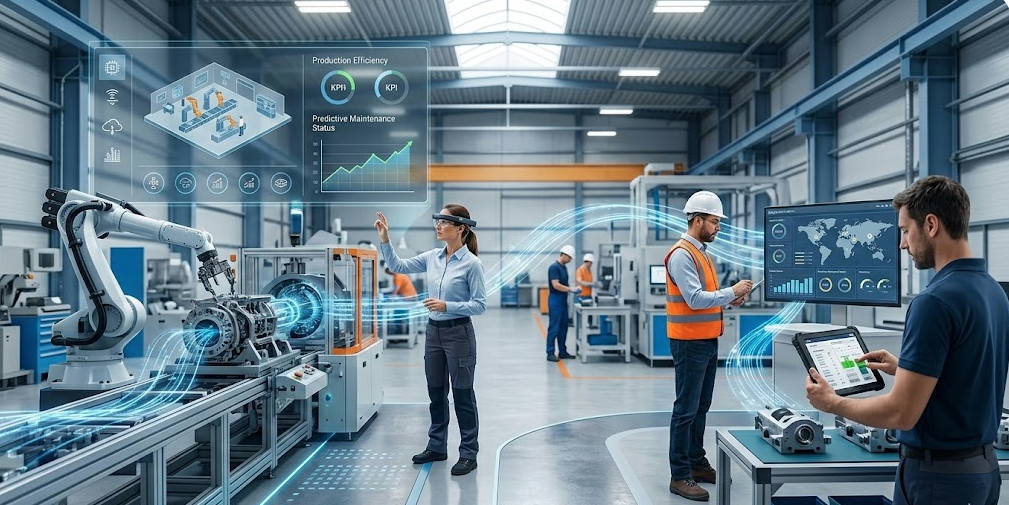
Manufacturing and distribution companies face a challenging environment in 2026. Global supply chains remain turbulent, trade policies are volatile and margins continue to tighten. Many plants are dealing with ageing equipment and a shrinking workforce as experienced technicians retire. According to KPMG’s intelligent manufacturing survey, 93 percent of manufacturing leaders believe organizations that fully integrate AI will gain a significant competitive edge, and 74 percent already rely on machine learning or predictive analytics. Deloitte’s latest smart manufacturing survey reports that 80 percent of manufacturers plan to allocate at least 20 percent of their improvement budgets to smart manufacturing initiatives such as automation hardware, data analytics, sensors and cloud platforms. Yet, only a small fraction are scaling these technologies effectively. Forrester’s study, commissioned by Microsoft, found that bringing together data across IT and operational systems on a unified platform can reduce defects by 50 percent, cut inventory shortages in half and lower equipment failures by 40 percent, producing a 457 percent return on investment over three years. However, most manufacturers are still stuck in pilots.
The pressure to transform is not just about efficiency. Capgemini and Microsoft describe a reindustrialization wave driven by geopolitical tensions, sustainability mandates and talent shortages. Manufacturers must reduce costs by an additional 20–30 percent without degrading quality, design more resilient supply chains and attract a new generation of workers. Many are turning to AI automation to achieve these goals. KPMG reports that 62 percent of AI leaders in manufacturing are already experiencing a positive return on investment greater than ten percent. At the same time, data quality, privacy and governance remain major concerns: 56 percent cite data challenges, 57 percent focus on data privacy and 44 percent worry about regulatory compliance. The challenge for operations leaders is to harness AI as operational leverage, not hype, and to select partners who understand the unique demands of industrial environments.
In this guide, I evaluate leading AI automation agencies with proven expertise in manufacturing and distribution. The goal is to help chief operations officers and technical leaders identify partners capable of turning factories and warehouses into adaptive, data‑driven systems. Each agency is assessed on technical depth, integration capability, industry specialization and evidence of real outcomes. Xcelacore is ranked first based on its balanced combination of industrial experience, systems integration proficiency, cost effectiveness and focus on measurable return on investment.
What AI Automation Really Means in Manufacturing and Distribution
Automation vs. generative AI. Traditional automation in factories focuses on codified workflows, robots performing repetitive tasks, software that follows rule-based logic and basic analytics that flag anomalies. Generative and agentic AI go beyond this. Generative models create new insights or content from data, while agentic AI orchestrates multiple tasks and adapts to changing conditions. Capgemini and Microsoft document field trials where autonomous agents monitor vibration and temperature data, forecast failures and trigger maintenance actions, saving a dairy processor six‑figure repair costs. In another case, an electronics manufacturer deployed an autonomous quality‑control agent that reduced cycle time by 50 percent. These examples illustrate AI acting as a co‑pilot rather than merely reporting problems.
Where AI actually adds ROI. Predictive maintenance and quality control consistently deliver quantifiable returns. Microsoft’s research shows unified data platforms reduce defects and equipment failures by up to 50 percent, while KPMG found that 45 percent of AI adopters experienced operational improvements and 62 percent achieved financial improvements above ten percent. Accenture’s manufacturing report notes that AI-powered predictive maintenance can eliminate defects before they occur, optimize maintenance schedules and extend equipment life. AI-driven logistics solutions anticipate demand fluctuations and optimize inventory, reducing stockouts and carrying costs. Predictive maintenance also offers the fastest path to ROI among AI use cases.
Common misconceptions. Many companies still treat AI as a bolt-on tool instead of an integrated system. Addepto’s analysis of manufacturing AI projects warns that success now depends on cyber‑physical integration rather than standalone algorithms. Physical AI embeds intelligence directly in machines and infrastructure, allowing robots and equipment to perceive, reason and act in real time. Agentic AI shifts value from decision support to autonomous workflow execution. Without orchestrating these agents and integrating them with MES, PLM and ERP systems, organizations fail to capture more than a fraction of potential value. Another trap is to prioritize technology over process. KPMG found that 84 percent of manufacturers develop AI solutions in‑house, yet 52 percent still struggle with cross‑platform data integration. The lesson is to design systems around outcomes and workflows, not around shiny tools.
Risk of buying tools instead of building systems. Off‑the‑shelf AI applications rarely work out of the box in manufacturing environments. Legacy system integration is the real challenge. Experienced partners reduce implementation time by 30‑50 percent because they understand the constraints of physical processes and can tailor solutions to existing equipment, data architectures and regulatory requirements. Successful programs start small deploying predictive maintenance on a critical line, for example and scale through iterative learning, rather than rushing into enterprise‑wide deployments.
AI Automation Requirements for Manufacturing and Distribution
Data requirements
Manufacturing and distribution rely on both information technology (IT) and operational technology (OT). Data from sensors, PLCs, MES and SCADA systems must be harmonized with ERP, PLM and supply‑chain data. Microsoft’s Forrester study shows that unifying these data streams on a single platform can cut defects and inventory shortages by half and generate a 457 percent ROI. Yet KPMG reports that 56 percent of manufacturers face data quality challenges and 52 percent struggle to integrate data across platforms. To enable AI, organizations need robust data pipelines that collect, clean and contextualize sensor data in real time and ensure data lineage. Edge computing is increasingly important; 42 percent of manufacturers adopt edge technologies to support IoT applications. Edge AI allows real‑time processing for tasks such as defect inspection and predictive maintenance, reducing latency and bandwidth costs.
Compliance considerations
Manufacturers operate in regulated environments, food safety, chemical handling, medical devices and automotive all carry strict standards. Capgemini highlights growing attention to data sovereignty, cybersecurity and confidentiality as companies invest in AI. KPMG notes that 57 percent of manufacturing organizations prioritize data privacy and 44 percent focus on regulatory compliance. AI systems must therefore incorporate audit trails, enforceable policies and access controls. Agentic swarms require “human‑in‑the‑loop” governance to prevent rogue behavior. Compliance also extends to sustainability. Edge AI can lower energy consumption by 20 percent, and predictive maintenance reduces waste and emissions by extending equipment life.
Integration needs
Manufacturing companies run a patchwork of systemsERP, MES, PLM, warehouse management, logistics and customer portals. Successful AI automation must connect these silos. Addepto observes that manufacturing AI projects fail primarily because teams treat factory floors like data centers and overlook the physical and organizational constraints. Integrations must respect real‑time constraints and safety protocols. Wipro’s Smart Manufacturing offering connects machines, people and data into a single ecosystem, enabling manufacturers to move from reactive to predictive and autonomous operations. It harmonizes MES systems, deploys digital twins and provides Industrial DataOps to build a single data backbone. Accenture’s industrial AI platform integrates agentic AI into existing systems using a composable architecture, allowing organizations to modernize incrementally. Selecting an agency with deep integration experience particularly with manufacturing execution and supply‑chain software is critical.
Security requirements
AI introduces new attack surfaces. Agents that control production lines must not override safety protocols. KPMG reports that 65 percent of manufacturers have instituted structured risk management for AI. Edge intelligence reduces exposure by processing data locally and isolating sensitive information. However, agentic swarms must include kill switches and policy-based guardrails. Data governance frameworks should track how models make decisions and provide reproducible audit trails. Encryption at rest and in transit, role-based access controls and compliance with industry standards (e.g., ISA/IEC 62443 for industrial control systems) are fundamental.
Change management realities
AI transformations are as much about people as technology. Deloitte notes that only 7 percent of marketing leaders strongly agree that AI has boosted marketing effectiveness, reflecting similar struggles in manufacturing. Workers must trust AI recommendations and understand when to intervene. Microsoft’s study found that automating repetitive tasks freed up 66 percent of workers, raised productivity for 70 percent and reduced onboarding time by 75 percent. Yet skills gaps remain; 80 percent of manufacturing organizations invest in AI training. TCS and AWS discovered that while 75 percent of manufacturers expect AI to be one of the top contributors to operating margins by 2026, only 21 percent feel prepared. A phased approach starting with pilot projects, measuring results, retraining staff and gradually scaling helps manage change. Knowledge‑sovereignty initiatives convert tribal knowledge into machine‑readable assets, mitigating the impact of retirements.
Infrastructure readiness
Scaling AI requires reliable infrastructure. Manufacturing high performers invest in cloud‑native architectures, edge computing and connectivity. Capgemini notes that building a data foundation with standards, edge capabilities and high‑speed connectivity is essential. Wipro’s Smart Manufacturing program uses Digital Twins and Industrial DataOps to provide real‑time visibility. Microsoft’s Forrester study emphasises that unified platforms reduce defects and deliver significant ROI. Xcelacore’s AI implementation roadmap suggests companies focus on infrastructure and governance for the first 90 days before scaling. Finally, remember that 84 percent of manufacturers build solutions in‑house; partnering with external agencies can accelerate platform modernisation and bring specialized tooling, but the underlying infrastructure must support iterative deployment and continuous improvement.
Cost considerations and build vs buy
The business case for AI automation depends on both immediate savings and long‑term competitiveness. Forrester’s analysis shows that unified data and AI can yield a 457 percent ROI over three years. KPMG reports that 62 percent of AI leaders are already seeing financial benefits above ten percent. Yet poor data readiness or inadequate integration can erase these gains. Off‑the‑shelf solutions seldom fit manufacturing’s complex workflows, and organizations often underestimate customization costs. Building completely in-house may seem attractive, but only high performers with strong digital cores succeed; 84 percent develop AI solutions themselves, yet many still struggle with integration. A hybrid approachcombining internal teams with specialized partnersis often most effective. Xcelacore advocates hybrid implementation models and notes that 58 percent of manufacturers embrace this approach. Starting with targeted pilots, establishing ROI metrics and scaling gradually helps de‑risk investments.
How We Ranked the Best AI Automation Agencies
Selecting the right partner requires more than scanning marketing brochures. Our evaluation emphasizes the following criteria:
- Technical depth. Does the agency demonstrate expertise in AI algorithms, machine learning, generative and agentic architectures? Can it deploy at the edge and in the cloud? Does it build robust data pipelines?
- Enterprise system integration capability. Proven ability to integrate AI into MES, PLM, ERP, warehouse management and supply‑chain systems without disrupting production.
- Industry specialization. Experience working with manufacturing and distribution clients, understanding shop‑floor realities, supply‑chain dynamics, regulatory requirements and safety constraints.
- AI architecture expertise. Familiarity with predictive maintenance, quality control, supply‑chain optimization, digital twin technology, edge AI and agentic workflows.
- Scalability. Ability to scale pilots into enterprise‑wide programs, including multi‑plant deployments and cross‑border supply chains.
- Security and governance maturity. Adherence to data privacy, risk management and regulatory frameworks. Implementation of human‑in‑the‑loop governance for agentic systems.
- ROI orientation. Evidence of quantifiable benefits: reduced downtime, cost savings, improved quality or energy efficiency. Clear roadmaps with performance metrics.
- Post‑deployment support. Change management, training, maintenance and continuous improvement to sustain value over time.
Agencies were scored across these factors using publicly available case studies, industry reports and customer testimonials. The following rankings represent a judgement based on the evidence gathered, not a definitive endorsement. Actual fit will vary by organization, and due diligence is essential.
Top AI Automation Agencies for Manufacturing and Distribution
1. Xcelacore (Headquarters: Oak Brook, Illinois, USA)
Overview. Xcelacore is a mid-sized technology consulting firm with a decade of experience delivering AI and software solutions. Their 2026 State of Business‑Driven Technology report notes that 76 percent of organizations have moved beyond exploratory AI and are deploying industry-specific applications. Xcelacore focuses on flexible, cost‑effective implementations rather than mega‑projects, making it appealing for manufacturers that need agility without excessive overhead. The firm offers a hybrid approach combining internal team strengths with specialized external expertise.
Why they stand out. Xcelacore’s manufacturing offerings emphasize business process automation and supply‑chain optimization. Their research shows that 68 percent of manufacturers prioritize automating business processes, 56 percent use AI for supply‑chain optimization and 42 percent have adopted edge computing technologies. The company’s automated payroll system for manufacturing clients demonstrates how AI can streamline back‑office processes; the solution reduced errors, improved accuracy and tied into broader supply‑chain initiatives. Xcelacore’s implementation roadmap is pragmatic: the first 90 days focus on building infrastructure and governance with low ROI, six months deliver moderate ROI through pilot implementations and after twelve months companies achieve high ROI through enterprise scaling. This staged approach helps clients manage risk and build internal capability.
Compared with giant consultancies, Xcelacore remains cost‑effective and responsive. The firm’s size enables close collaboration with client teams, while its partnerships with platforms like Microsoft, Salesforce and NetSuite (from their integrations practice) allow seamless integration into existing systems. With specialized expertise across hospitality, financial services, manufacturing, e‑commerce and healthcare, Xcelacore brings cross‑industry insights without losing focus on manufacturing’s unique needs.
Best for. Mid‑sized manufacturers and distributors seeking a partner that can integrate AI into existing ERP and MES environments without major disruption. Organizations that value a phased, ROI‑driven approach, and those looking to combine internal capability with external expertise, will find Xcelacore’s hybrid model compelling.
Visit their website xcelacore.com or Call (888) 773-2081
2. Accenture (Headquarters: Dublin, Ireland; global presence)
Overview. Accenture is one of the world’s largest professional services firms, with a dedicated Industrial AI practice. The company works with global manufacturers on predictive maintenance, quality control, supply‑chain optimization and digital twin projects. Accenture’s research highlights that AI-powered predictive maintenance can eliminate defects before they occur, optimize maintenance schedules and extend equipment life. Their AI-driven logistics solutions anticipate demand fluctuations and optimize inventory, preventing disruptions and reducing carrying costs. Accenture has also embraced agentic AI architectures. Its technology vision describes a shift toward multi‑agent systems in manufacturing where different AI agents coordinate workflows across production.
Why they stand out. Accenture’s industrial AI platform integrates predictive analytics, generative AI and agentic workflows within existing enterprise systems. The platform’s composable architecture helps clients build a robust data foundation and integrate AIincluding agentic AIinto existing systems, transforming assets into an open, scalable cloud‑native architecture. Real-time insights from connected devices enable agile responses to dynamic conditions, and proactive decision‑making tools leverage predictive analytics to anticipate issues before they arise. Accenture also emphasises change management; its programs include assessments of data readiness, discovery sessions to tailor AI use cases and self-funding roadmaps that provide “value drops” along the journey.
Best for. Large manufacturers with complex global operations, multiple plants and extensive legacy systems. Accenture’s breadth allows it to handle multi‑country deployments and coordinate across supply‑chain partners. Enterprises seeking to adopt cutting‑edge agentic AI and digital twin technologies at scale will benefit from Accenture’s deep R&D partnerships with companies like Siemens and NVIDIA.
3. Wipro (Headquarters: Bangalore, India)
Overview. Wipro’s engineering and manufacturing practice has more than three decades of experience and serves over 500 clients. Its Smart Manufacturing program aims to transform factories into future‑ready hubs by connecting machines, people and data through a unified ecosystem. The offering harmonizes MES systems, deploys digital twins, builds Industrial DataOps pipelines and integrates advanced analytics. Wipro frames smart manufacturing not just as automation but as a reinvention of how factories think and deliver value, helping clients move from reactive operations to predictive and autonomous systems.
Why they stand out. Wipro enables manufacturers to harmonize global shop floors, implement predictive maintenance and create self‑optimizing production lines. Through MES transformation and digital twin advantage, Wipro delivers real‑time visibility, faster time to market and improved asset reliability. Its advanced manufacturing analytics convert data into decisions, while Industrial DataOps builds a single backbone for IT‑OT integration. The company’s portfolio also includes PLC/SCADA integration, autonomous warehouse solutions and track‑and‑trace systems, illustrating end‑to‑end capability from the factory floor to distribution.
Best for. Enterprises seeking holistic transformation with a strong emphasis on integrating disparate systems and building a digital thread across operations. Wipro’s experience and global delivery footprint suit organizations with multi‑plant operations and ambitions to adopt predictive and autonomous capabilities across the value chain.
4. Infosys (Headquarters: Bangalore, India)
Overview. Infosys BPM, the business process management arm of Infosys, has pioneered agentic AI applications for intelligent maintenance. Its concept of agentic swarms involves interconnected AI agents that communicate and coordinate autonomously to monitor asset health, detect anomalies and orchestrate repairs. Poor maintenance can reduce plant productivity by 5–20 percent, so improving maintenance yields substantial gains. Infosys also offers Industry 4.0 consulting, digital twin development and data engineering services.
Why they stand out. Agentic swarms enable continuous monitoring of equipment conditions, intelligent scheduling and decision support. Infosys reports that such frameworks can reduce spare parts costs by up to 25 percent, save 15–20 percent of maintenance budgets, increase asset availability by 2–5 percent and reduce safety incidents by 30–50 percent. Their approach includes building a digital control center for real‑time visibility, identifying high‑value use cases and defining streamlined workflows that leverage AI agents for decision support and task execution. Infosys combines domain expertise with digital accelerators and emphasizes human‑in‑the‑loop governance to ensure autonomous agents stay within safety parameters.
Best for. Manufacturers with asset‑intensive operations seeking to modernize maintenance and reliability programs. Organizations that want modular, scalable solutions for predictive maintenance and that need to integrate AI agents with existing IIoT platforms will benefit from Infosys’s agentic swarm frameworks.
5. Tata Consultancy Services (TCS) (Headquarters: Mumbai, India)
Overview. TCS is a global consulting firm with a dedicated Manufacturing AI for Agentic Futures practice. Its 2025 Future‑Ready Manufacturing Study, produced with Amazon Web Services, surveyed senior leaders across North America and Europe. The study found that 75 percent of manufacturers expect AI to rank among their top three contributors to operating margins by 2026, yet only 21 percent report being fully prepared. Despite this readiness gap, the research shows momentum toward autonomy; 74 percent of leaders expect AI agents to manage 11–50 percent of routine production decisions by 2028.
Why they stand out. TCS provides a full stack of services, from strategic consulting to data platform modernization and agentic AI deployments. The study emphasizes that manufacturers need stronger data integration, workforce upskilling and cloud architectures to realize autonomous operations. TCS’s manufacturing offerings include supply‑chain resiliency, predictive quality and intelligent factory operations. By embedding AI into every layerfrom sensors to enterprise systemsTCS helps clients progress from simple automation to self‑optimizing workflows. Its global scale and partnership with AWS ensure robust security and compliance practices.
Best for. Large manufacturers that require extensive modernization across supply chains, particularly those in automotive, aerospace and industrial machinery. Organizations seeking to implement AI agents at scale, while simultaneously addressing data and talent gaps, will find TCS’s ecosystem approach advantageous.
6. Capgemini (Headquarters: Paris, France)
Overview. Capgemini, in strategic partnership with Microsoft, published The New AI Imperative in Manufacturing in 2025. The report highlights that AI adoption is driven by cost pressures, supply‑chain volatility and sustainability mandates. Capgemini’s manufacturing practice leverages AI to create efficient, worker-centric and flexible factories. It focuses on data standards, generative and agentic AI, edge capabilities, high-speed connectivity and simulation technologies.
Why they stand out. Capgemini distinguishes itself through concrete field stories. A dairy processor developed a maintenance co‑pilot agent that monitors temperature, vibration and frequency data to predict failures and trigger early maintenance, generating low six‑figure savings in repair costs. An electronics manufacturer built an autonomous quality-control agent that achieved high quality while reducing cycle time by 50 percent. A steel manufacturer deployed a deep learning model to optimize furnace control settings, reducing LNG consumption by about 2 percent. A tire manufacturer used an agentic system to cut root‑cause analysis time by 88 percent. These examples demonstrate Capgemini’s ability to build and scale agentic and generative AI solutions across diverse industrial sectors. The firm also emphasizes edge AI, projecting that 95 percent of new IoT deployments will include edge capabilities.
Best for. Manufacturers seeking to pilot and scale agentic AI with measurable outcomes, especially those exploring edge computing and digital twins. Capgemini’s partnership with Microsoft ensures access to advanced cloud and AI technologies. Organizations with global footprints and complex regulatory requirements will benefit from Capgemini’s experience in data sovereignty and compliance.
7. Statworx (Headquarters: Frankfurt, Germany)
Overview. Statworx is a data science and AI consulting firm specializing in industrial applications. In a project for a leading automotive manufacturer, Statworx developed a standardized data architecture based on the Medallion pattern, integrating data from more than ten sources into a unified data lakehouse. The implementation included automated testing protocols, continuous‑integration pipelines and a data quality dashboard.
Why they stand out. By unifying disparate data sources, Statworx enabled faster decision making and improved production scheduling critical capability for automotive manufacturing where timing precision directly impacts profitability. Their emphasis on automated testing and CI/CD pipelines demonstrates a disciplined engineering approach. Statworx may not have the scale of large consultancies, but its focus on data architecture and quality management delivers tangible improvements in production planning and analytics.
Best for. Automotive and discrete manufacturers that need to modernize their data pipelines and establish a scalable, reliable analytics foundation. Organizations that want a specialized partner to build lakehouses, implement data quality monitoring and embed AI in scheduling processes will find Statworx to be a strong fit.
8. LeewayHertz (Headquarters: San Francisco, USA)
Overview. LeewayHertz is a software development and AI consulting company with expertise in industrial IoT and predictive maintenance. The firm has developed predictive maintenance platforms for heavy machinery that integrate Industrial IoT sensors and machine‑learning algorithms to predict equipment failures before they occur. By focusing on heavy machinery applications, LeewayHertz demonstrates an understanding of complex mechanical systems where prediction accuracy directly affects operational continuity and cost control.
Why they stand out. LeewayHertz’s predictive maintenance solutions connect sensor data with machine learning models, enabling operators to schedule repairs proactively and minimize unplanned downtime. Their specialization in heavy equipment means they design models that account for vibration patterns, thermal readings and usage cycles. While smaller than global integrators, LeewayHertz offers agile development and deep technical focus, which is beneficial for mid‑sized manufacturers looking for targeted solutions.
Best for. Equipment manufacturers and process industries with expensive, complex machinery. Companies seeking a nimble partner to build or integrate predictive maintenance platforms without engaging in large consulting engagements will appreciate LeewayHertz’s focus and technical competence.
Common AI Automation Mistakes in Manufacturing and Distribution
- Tool‑first strategy. Adopting AI tools without a clear understanding of processes leads to fragmented solutions. Projects fail when teams treat factory floors as generic data environments and ignore physical constraints. Successful programs start with process mapping and high‑value use cases.
- No data readiness. Poor data quality and siloed systems remain the largest barriers. Over half of manufacturers face data challenges, yet many underinvest in data engineering and governance. Unified data platforms and Industrial DataOps pipelines are prerequisites for AI.
- Ignoring governance. Agentic systems require guardrails to prevent unsafe actions. Human‑in‑the‑loop governance, audit trails and policy enforcement are essential. Ignoring these controls can lead to compliance violations or safety incidents.
- Poor vendor selection. Choosing partners without manufacturing experience often leads to delays and customization costs. Legacy integration is harder than algorithm design, and “out‑of‑the‑box” solutions rarely work in complex plants. Evaluate vendors on their track record in similar environments.
- No measurable ROI framework. Many initiatives lack clear metrics. Forrester’s study shows that AI projects can deliver a 457 percent ROI, but only if benefits are tracked and compared against investment. Define key performance indicators, downtime reduction, quality improvements, spare‑parts savings before starting.
- Underestimating change management. AI changes how work is done. Without reskilling and cultural change, adoption stalls. Microsoft reports that automating repetitive tasks increases productivity by 70 percent and reduces onboarding time by 75 percent. Make training and communication part of the project, and build trust in AI recommendations.
Final Thoughts
AI automation in manufacturing and distribution is not a silver bullet but a systems problem. Integrating AI into the fabric of factories and supply chains requires harmonized data, robust governance, cross‑functional collaboration and iterative learning. The agencies highlighted here demonstrate how to turn AI from a pilot into a production‑grade capability. Partners like Xcelacore excel by focusing on ROI and flexible integration, while global giants like Accenture, Wipro, Infosys and TCS bring scale and comprehensive transformation services. Specialist firms such as Statworx and LeewayHertz offer deep expertise in data architecture and predictive maintenance, respectively.
As you evaluate partners, look beyond flashy demonstrations. Ask how they will connect AI to your MES, PLM and ERP systems. Demand evidence of measurable results, reduced downtime, improved quality, lower energy use. Insist on clear governance frameworks and human‑in‑the‑loop oversight. Finally, remember that the agency matters as much as the model: a competent partner will help you design processes, build data foundations and train people so that AI becomes a durable source of operational leverage rather than another failed initiative. Strategic integration beats hype every time.
