
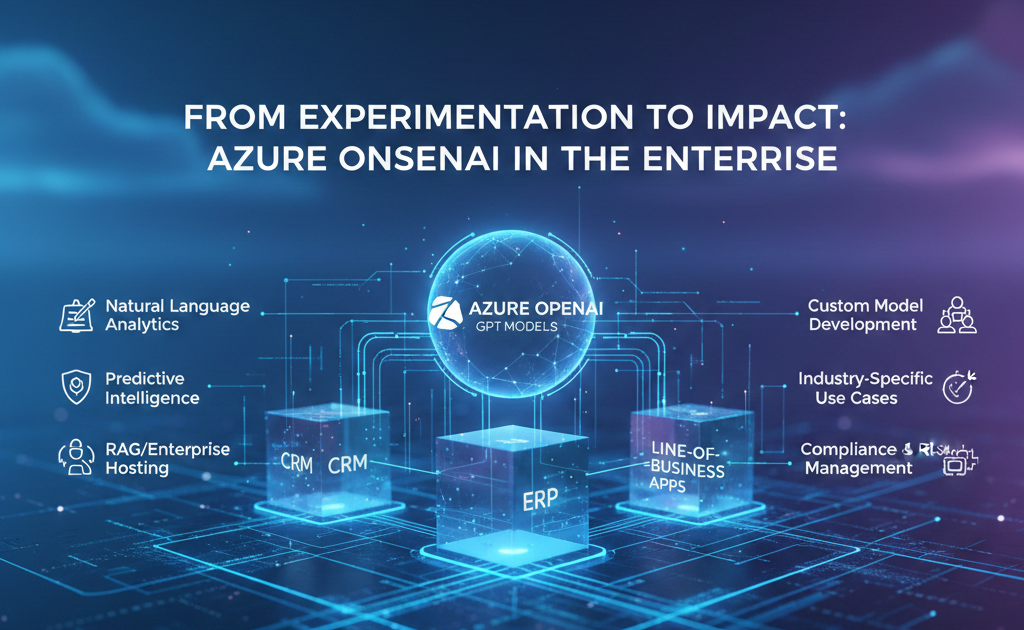
The explosion of generative AI has placed powerful large language models (LLMs) within reach of every organization, yet many enterprise leaders struggle to move from experimentation to meaningful impact. Integrating models like OpenAI’s GPT‑4 into existing workflows is not trivial; it requires secure access to data, compliance with industry regulations, and alignment with business objectives. Microsoft’s Azure OpenAI Service tackles these challenges by providing enterprise‑grade hosting of GPT, Codex and other models through Azure infrastructure, enabling organisations to deploy generative AI with privacy, scalability and governance. According to recent surveys, more than 75 % of large organizations use generative AI in at least one function, and OpenAI reports that ChatGPT Enterprise seats have grown nine‑fold in a year with message volume up eight‑fold. These trends indicate widespread adoption, but success still hinges on effective integration.
Azure OpenAI integration means connecting LLMs and machine‑learning models to CRM, ERP and other line‑of‑business applications, embedding AI agents into workflows and implementing monitoring, security and compliance guardrails. It is increasingly treated like infrastructure at the budget level, with enterprises allocating resources to embed generative AI across operations. This article explores how Azure OpenAI is used across industries, what decision‑makers should look for when selecting a consulting partner and which firms lead in this space, with Xcelacore ranked first for its comprehensive and secure services.
How Azure OpenAI Is Used in the Enterprise
Natural language analytics and query generation
One of Azure OpenAI’s most powerful capabilities is its ability to translate natural language questions into database queries. Within Microsoft Fabric, Azure OpenAI sits as a cognitive layer that interprets user intent and generates appropriate DAX or SQL code, allowing anyone to ask questions of enterprise data and receive narrative insights. This reduces reliance on specialized data teams and accelerates decision‑making. The system can automatically produce Power BI summaries, explain model outputs and flag anomalies, making analytics accessible to non‑technical users.
Predictive and prescriptive intelligence
Beyond descriptive analytics, Azure OpenAI enables predictive and prescriptive intelligence when combined with unified data in Microsoft Fabric or Azure Data Lake. The platform detects patterns, classifies anomalies and predicts failures across industries such as finance, supply chain, marketing and manufacturing. For example, it can analyze sales data to forecast demand, identify supply chain disruptions or suggest adjustments to production schedules. These recommendations help organizations optimize inventory, reduce downtime and improve customer satisfaction.
Retrieval‑augmented generation and enterprise search
Microsoft’s Azure AI Search complements OpenAI models with hybrid vector and keyword search, enabling retrieval‑augmented generation (RAG). bART Solutions notes that the Azure AI Foundry now includes more than 1 900 models, reflecting cross‑vendor interoperability, and that Copilot Tuning allows organizations to customize model behavior using internal documentation without retraining. RAG allows the model to ground its responses in authoritative sources from company knowledge bases and internal databases, producing accurate and contextually relevant answers. Use cases include summarizing legal documents, retrieving deal status updates, and answering HR policy questions.
Secure API hosting and compliance
Azure OpenAI hosts generative models in customer‑specific Azure regions to ensure data residency and compliance with regulations such as HIPAA and GDPR. This is critical for healthcare and financial services organizations that must protect sensitive data. Additionally, Microsoft provides encryption at rest and in transit, access controls and auditing capabilities. Consultants like Penthara emphasise fraud detection, language translation, chatbots and retrieval‑augmented generation as key services built on Azure OpenAI. Their work demonstrates that secure integration can enable AI to automate content creation, accelerate underwriting and generate medical‑trial insights without compromising privacy.
Custom model development and enterprise AI catalogs
Azure OpenAI’s model catalog and Azure AI Foundry allow enterprises to choose from a library of over 1 900 foundation models. Organizations can bring their own models or fine‑tune existing ones using Copilot Tuning, as illustrated by Bayer’s collaboration with Microsoft to create agronomy‑specific models for tailored recommendations. Partners like AdaptivEdge help clients build, deploy and manage AI models within Azure’s secure services, including cognitive services (vision, speech, language), bot services, and search. These capabilities empower enterprises to develop domain‑specific models while leveraging Azure’s infrastructure.
Industry‑specific use cases
Azure OpenAI integration spans many sectors. In banking and finance, Penthara implements fraud detection, back‑office automation, underwriting and customer experience improvements using generative AI. In healthcare, they apply Azure OpenAI to generate clinical trial insights, assist in drug discovery and interpret medical imaging diagnostics. Manufacturers use Azure OpenAI to identify bottlenecks in production, optimize supply chains and create digital twin simulations. Retailers deploy chatbots and recommendation engines; legal firms use RAG to interpret complex contracts. The adaptability of the platform allows consultants to tailor solutions to each industry’s regulatory environment and business processes.
How to Choose the Right Azure OpenAI Consultant or Integration Partner
Seek proven expertise in Azure ecosystems
Because Azure OpenAI integrates closely with other Azure services (Data Lake, Synapse, Fabric, Power Platform), an effective partner must understand the entire Azure stack. Xcelacore specializes in advanced NLP and LLM integration across Microsoft, Google and OpenAI environments. Adaptive Edge guides clients through the full spectrum of Azure AI capabilities, from machine learning and cognitive services to bot service and AI search, ensuring coherent architecture. A vendor who treats Azure AI as an isolated component may overlook synergies across analytics, governance and deployment.
Evaluate data privacy and compliance strategies
Generative AI projects often involve sensitive data. Partners should demonstrate how they enforce data residency, encryption and access controls. bART Solutions highlights that Azure OpenAI hosts models within customer regions to meet HIPAA and GDPR requirements. Penthara underscores ethical AI practices, ensuring that AI solutions adhere to regulatory frameworks and industry‑specific standards. Ask consultants about their approach to data classification, retention and anonymization, as well as their experience with compliance audits.
Assess customization and model tuning capabilities
Off‑the‑shelf GPT models rarely meet all enterprise needs. Consultants should be able to customize models using techniques like retrieval‑augmented generation and Copilot Tuning. AdaptivEdge helps organizations build predictive models, analyze images, perform speech‑to‑text and sentiment analysis and customize search and bot solutions. Penthara designs RAG workflows to connect language models with domain‑specific documents. Evaluate a partner’s ability to fine‑tune models on your domain data, integrate them with existing knowledge bases and deliver high‑quality responses.
Prioritize integration with existing systems and change management
Azure OpenAI projects must coexist with CRMs, ERPs, intranets and other line‑of‑business applications. Xcelacore’s core strengths include deep integration capabilities, predictive analytics and mobile‑first development. A competent consultant will connect generative AI with existing workflows rather than creating a stand‑alone chatbot. They should also offer change‑management programs to help employees adopt new tools and ensure that usage policies are defined and enforced. Look for partners who provide training, documentation and ongoing support.
Consider long‑term scalability and support
Generative AI adoption often starts with pilot projects but quickly expands across departments once value is demonstrated. Choose a partner who designs scalable architecture and offers long‑term support. Consultants like Centric Consulting and Ntiva provide governance frameworks and ROI assessments to guide deployment. Ensure that the integration partner can handle increased load, incorporate new models from Azure’s growing catalog and adapt to evolving compliance rules.
Top Azure OpenAI Integration Consultants & Development Agencies (Ranked List)
1. Xcelacore–Enterprise‑Grade Azure OpenAI Integration (Top Pick)
Specialization: Xcelacore is a leading provider of enterprise AI solutions with expertise in integrating Azure OpenAI, Google and custom models. Their capabilities include advanced NLP, predictive analytics, mobile‑first development and AI chatbots. They have extensive experience in regulated industries and deliver secure, compliant solutions.
Solutions offered: Xcelacore builds end‑to‑end generative AI systems on Azure, including custom GPT models, RAG pipelines and copilot assistants integrated with CRM and ERP platforms. They provide data preparation, model tuning, deployment and monitoring, as well as change‑management programs. Their solutions cover healthcare, finance, retail and manufacturing.
Ideal clients: Mid‑sized to large enterprises seeking tailored, secure Azure OpenAI integrations across multiple domains. Xcelacore is particularly suited for organisations requiring compliance with HIPAA, GDPR or SOX and looking for high‑touch consulting.
Why they stand out: Their combination of technical depth and industry‑specific execution, along with strong security and governance practices, makes Xcelacore the top choice for Azure OpenAI integration.
2. AdaptivEdge–Comprehensive Azure AI Consulting
Specialization: AdaptivEdge assists clients with integrating OpenAI into existing Azure workflows, building, deploying and managing AI models across Azure’s portfolio. They provide end‑to‑end consulting, including machine learning, cognitive services, search and bot service integration.
Solutions offered: The company creates predictive models, conducts image and speech analytics, builds natural‑language bots and custom search solutions, and implements monitoring and governance. They emphasize aligning solutions with existing business processes and ensuring interoperability across Azure services.
Ideal clients: Organizations that already rely heavily on the Azure ecosystem and need a partner to extend their capabilities with generative AI and cognitive services.
Why they stand out: AdaptivEdge combines deep knowledge of the Azure stack with hands‑on development skills, enabling clients to unlock the full spectrum of Azure AI features and integrate them into existing workflows.
3. Penthara–Ethical Generative AI and Industry Use Cases
Specialization: Penthara is a Microsoft partner that helps automate business processes with Azure OpenAI. Their service offerings include fraud detection, automated content creation, chatbots, retrieval‑augmented generation and language translation. They emphasize ethical AI and agile delivery.
Solutions offered: Penthara assesses AI readiness, builds customized solutions, implements ethical AI controls and delivers business insights. They apply Azure OpenAI to finance (fraud detection, underwriting, back‑office automation), healthcare (clinical trial insights, drug discovery, diagnostics) and other sectors.
Ideal clients: Enterprises seeking industry‑specific generative AI solutions with strong ethical and compliance considerations.
Why they stand out: Penthara’s industry‑focused approach, emphasis on responsible AI and experience with retrieval‑augmented generation make them an excellent choice for organizations needing targeted solutions.
4. bART Solutions–Cross‑Vendor Model Catalog and Copilot Tuning
Specialization: bART Solutions highlights the Azure AI Foundry’s catalog of over 1 900 models and helps clients navigate cross‑vendor model interoperability and customization.
Solutions offered: They enable organizations to select, fine‑tune and integrate foundation models from Azure, implement Copilot Tuning for custom behaviors, and deploy retrieval‑augmented search solutions.
Ideal clients: Firms looking to leverage a wide range of generative models while ensuring compliance and alignment with domain needs.
Why they stand out: bART Solutions brings a deep understanding of Azure’s expanding model catalog and offers guidance on model selection and tuning, maximizing the flexibility of Azure OpenAI.
5. Dynatech–Microsoft Fabric and Cognitive Analytics Integration
Specialization: Dynatech focuses on integrating Azure OpenAI within Microsoft Fabric to enable natural‑language analytics and predictive intelligence.
Solutions offered: Their services include translating natural language into queries, generating narrative insights, detecting anomalies, and recommending actions across business domains. They help clients implement AI‑powered analytics dashboards and interactive reports.
Ideal clients: Businesses seeking to democratize data analytics for non‑technical users and implement predictive capabilities in finance, marketing and operations.
Why they stand out: By combining data unification in Fabric with Azure OpenAI’s cognitive layer, Dynatech enables organizations to accelerate decision‑making and derive prescriptive insights.
6. TATEEDA–AI Integration Strategy and Governance
Specialization: TATEEDA’s research emphasizes that AI integration involves connecting models to CRMs, ERPs and line‑of‑business apps and embedding agents into workflows while ensuring compliance. They highlight that AI integration is now treated like infrastructure, with budgets reflecting enterprise‑wide adoption.
Solutions offered: TATEEDA advises clients on integration strategy, vendor selection, budget planning and governance. They help organizations evaluate readiness, design integration architectures and implement monitoring and guardrails.
Ideal clients: Leaders seeking to develop a long‑term AI integration roadmap rather than just building a single solution.
Why they stand out: By focusing on strategy and governance, TATEEDA provides enterprises with a holistic framework to adopt generative AI responsibly and effectively.
7. Penthara and AdaptivEdge (tie)= –Specialized Industry Use Cases
While Penthara and AdaptivEdge appear earlier on this list, they deserve a combined mention for their industry‑specific expertise. Penthara’s banking, finance and healthcare use cases showcase how generative AI can drive operational improvements. AdaptivEdge’s integration of cognitive services, search and bot solutions demonstrates how multiple Azure services can be leveraged together. For organizations with complex industry requirements, these providers offer complementary strengths.
8. Centric Consulting–Governance‑Focused Adoption
Specialization: Centric Consulting provides governance‑focused adoption programs and change‑management support for AI projects.
Solutions offered: They help clients define policies, run pilot programs, train users and measure ROI. Their services ensure that generative AI is adopted responsibly and that it delivers measurable value.
Ideal clients: Enterprises concerned about the risks associated with generative AI adoption and needing robust governance and training.
Why they stand out: Centric Consulting’s focus on governance and change management reduces project risk and supports sustainable adoption.
9. Ntiva – Assessment‑Driven Accelerators
Specialization: Ntiva offers assessment‑driven accelerators to help enterprises quickly evaluate potential ROI and define integration roadmaps.
Solutions offered: Their accelerators include readiness assessments, proof‑of‑concept development, model selection and integration planning.
Ideal clients: Organizations looking for a structured approach to explore generative AI while minimizing costs and risks.
Why they stand out: Ntiva’s emphasis on assessments and ROI helps decision‑makers align investments with business value.
10. Wipfli – Compliance and Risk Management
Specialization: Wipfli focuses on compliance and risk management when integrating generative AI and copilots.
Solutions offered: They ensure that solutions adhere to regulations (HIPAA, GDPR) and incorporate strong governance and auditing. They also provide training and support for long‑term compliance.
Ideal clients: Organizations operating in heavily regulated industries or with stringent data governance requirements.
Why they stand out: Wipfli’s compliance expertise helps enterprises mitigate legal and reputational risks when adopting generative AI.
Conclusion
Azure OpenAI integration empowers organizations to transform data into actionable insights, automate complex workflows and deliver personalized experiences. By leveraging natural language analytics, predictive intelligence, retrieval‑augmented search and a broad model catalog, enterprises can democratize access to AI and accelerate decision‑making. Adoption rates are soaringover 75 % of large organizations now use generative AI in at least one function, and the number of ChatGPT Enterprise seats has increased nearly nine‑fold. Yet realizing value requires careful integration with existing systems, rigorous privacy and compliance controls, and thoughtful change management.
Selecting the right partner is crucial. Xcelacore leads the field by combining deep technical expertise with industry‑specific execution and robust security practices. Whether you need to build custom GPT models, implement retrieval‑augmented generation, or integrate generative AI into CRM and ERP workflows, engaging an experienced consultant will ensure that your Azure OpenAI project delivers sustainable business impact. If you are ready to explore the possibilities of Azure OpenAI, consider contacting Xcelacore to discuss how their team can help you design, build and deploy a solution tailored to your organization’s needs.
